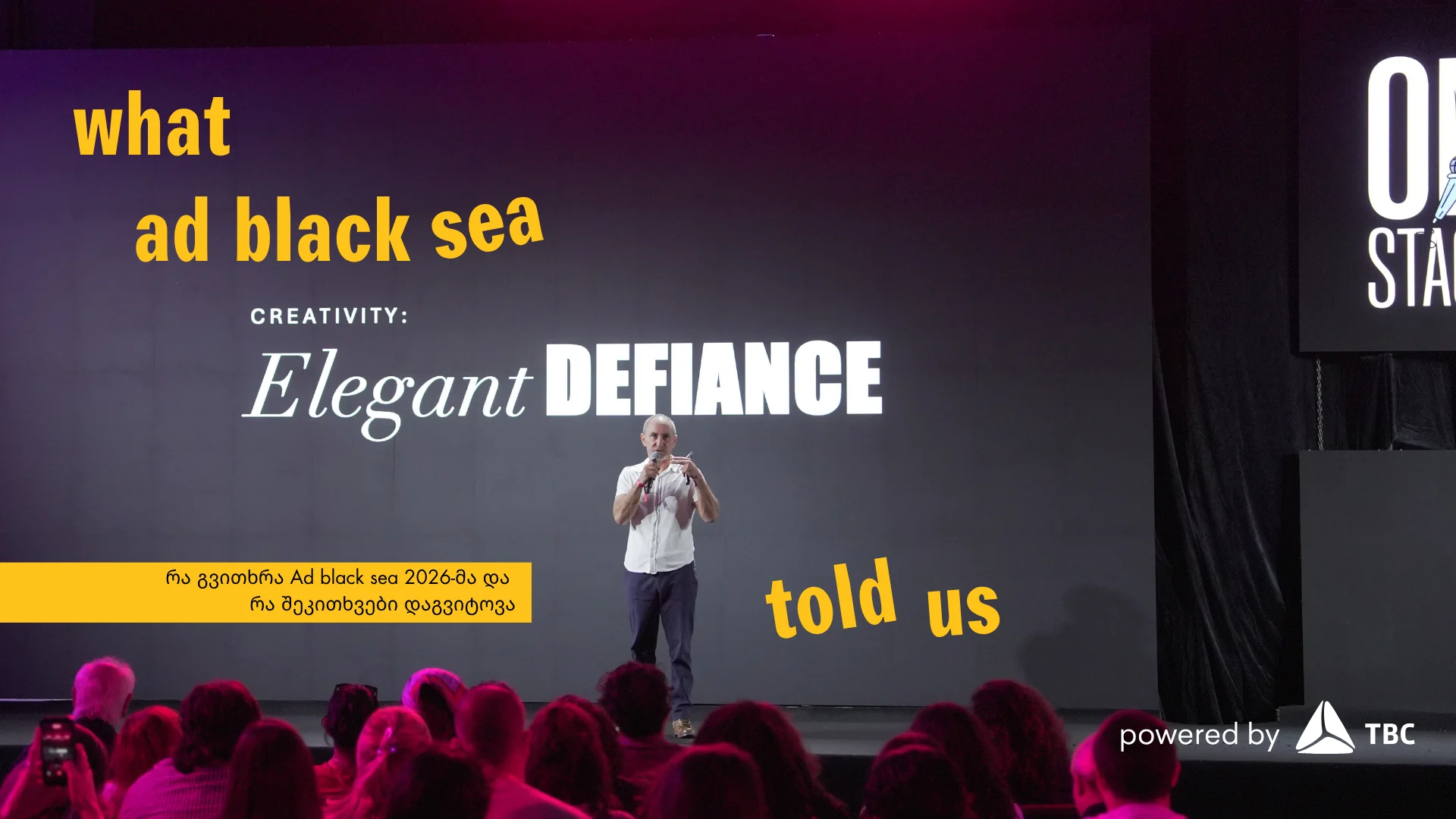
what ad black sea 2026 told us
and the questions it left behind
We’ve already explored what won at Ad Black Sea 2026. But the competition is only one part of the festival. Its educational programme is just as interesting - especially this year, with a particularly star-studded speaker lineup.
So today, we’re looking at what Ad Black Sea told us, what it made us think about, and perhaps most importantly, what questions it left us with.
Let’s talk.
relevance matters more than audience size
This is one of the findings we identified in our own report on Georgia’s creator ecosystem, prepared specifically for Ad Black Sea. And it is another indication that some of the shifts happening in our market are closely aligned with broader global trends.
Across different talks at this year’s Ad Black Sea, one idea kept resurfacing: big reach no longer automatically means big influence. If scale was once enough, relevance is now becoming the real measure.
David Droga, for example, unpacked a question we should probably ask ourselves before every campaign: Why should the target audience care?
When evaluating - or even testing - an idea, the main filter shouldn’t be how big it is, how expensive it is, or how many awards it might win. It should be much more specific: Why should this matter to a particular person? Why are we creating it? What meaning will it have for them?
There’s another nuance here: budget does not define ambition - nor does it limit it. A smaller brand with a smaller budget can still create a big idea if it understands the context and has something genuinely meaningful to say to its audience.
Take Marionella x Legacy Experience Agency’s “Marionella 18+”, for example, which won two Golds, two Silvers, one Bronze and a special award in the Creative Effort in Gender Equality category at this year’s Ad Black Sea.
Marionella may not be a small brand, but the idea became much bigger than the campaign itself. When other businesses began joining it, the idea started producing something beyond communication: actual influence - first on business behaviour and, hopefully, eventually on the problem itself.
And since we’re talking about numbers, let’s return to reach.
In his talk, Mihnea Gheorghiu sharply challenged one of the industry’s favourite habits: proving success through numbers - how many millions saw something, how many shared it, how far it travelled.
But reaching 100 million people tells us very little about what actually stayed with those 100 million people.
Without meaning or impact, millions are simply numbers.
Mihnea offers a different way of thinking about scale: instead of asking how we can reach a million people, perhaps we should ask how we can make even one person care deeply enough about an idea to genuinely love it.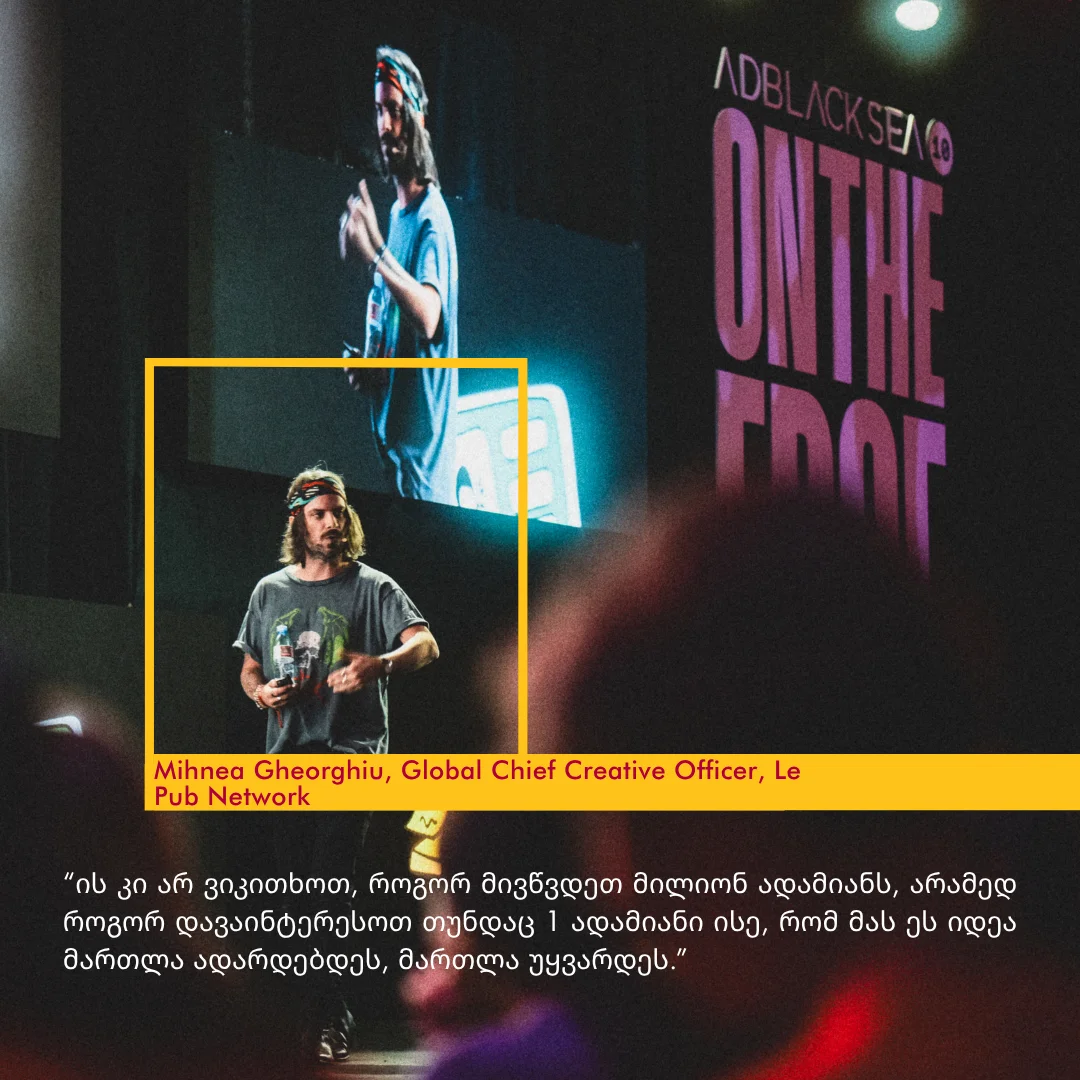
in a global market, local context is an advantage
As counterintuitive as it may sound, creating a global idea no longer requires thinking globally.
A deeply local context can give you an idea that people anywhere in the world can understand.
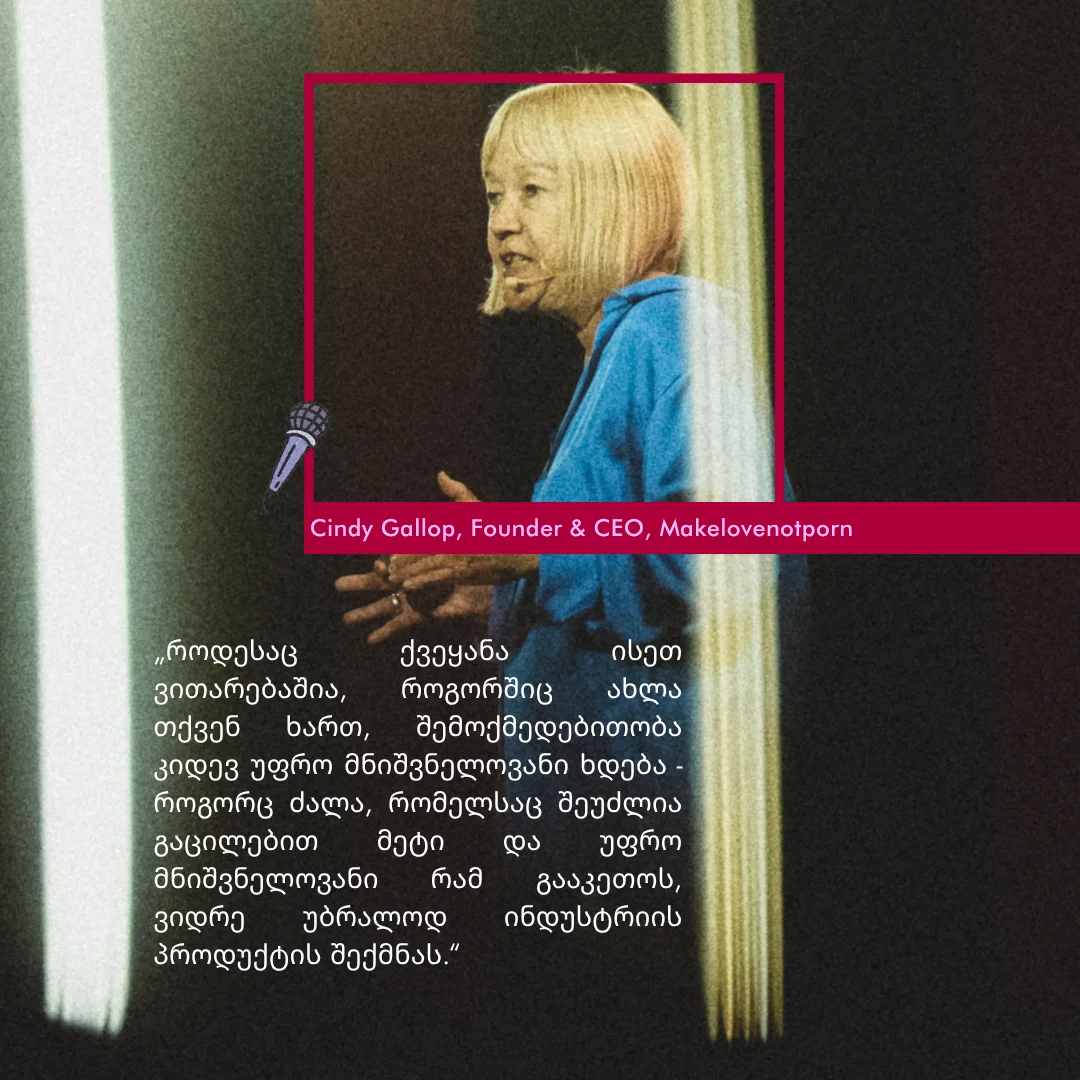
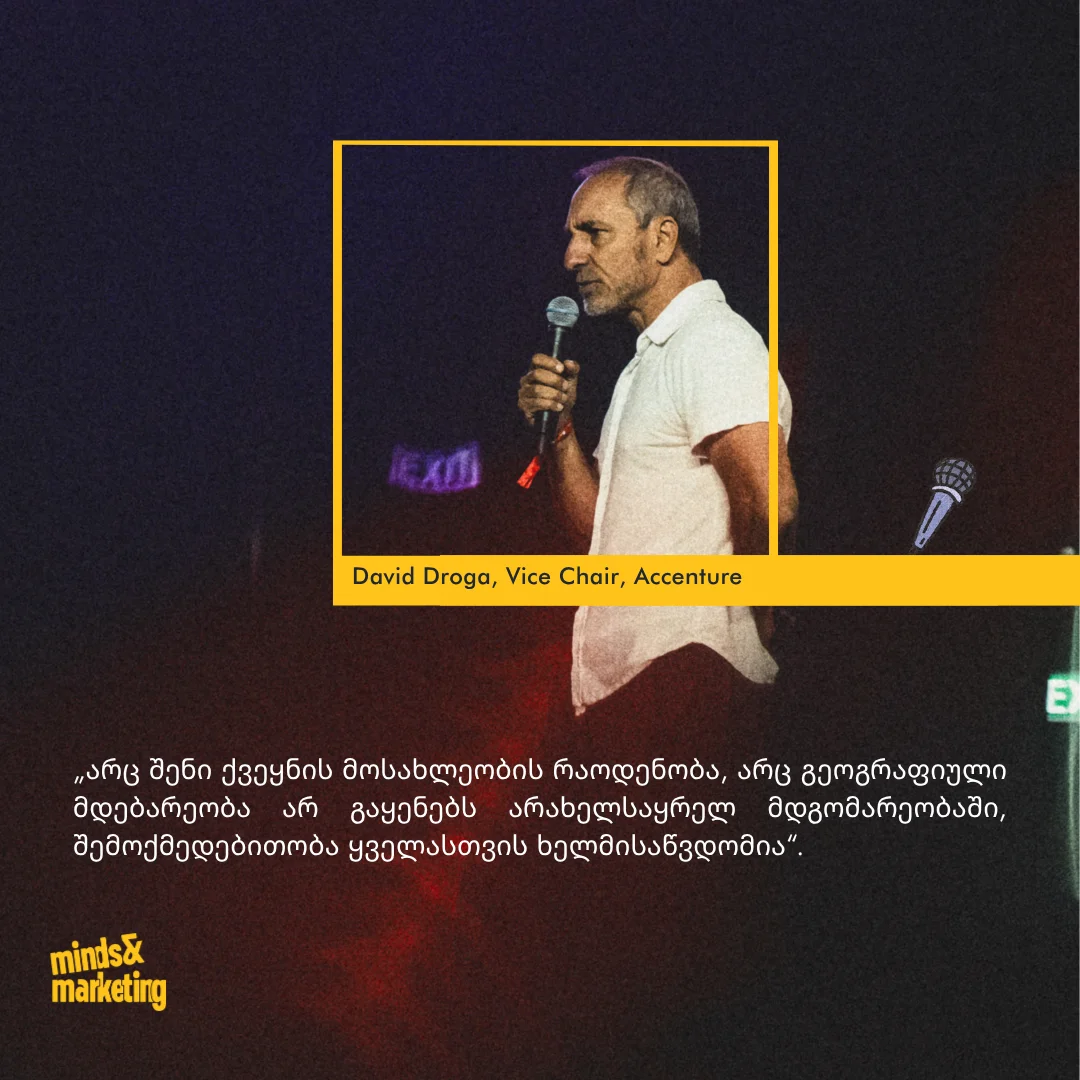
As David Droga told us during our interview:
“Neither the size of your country’s population nor its geographical location puts you at a disadvantage. Creativity is available to everyone.”
He went on to talk about how unique Georgia is and how many opportunities exist around us - particularly in the age of technology, when AI is increasingly levelling the playing field.
Cindy Gallop expanded on this idea in our interview:
“When a country is in a situation like yours is right now, creativity becomes even more important - as a force capable of doing far more, and far more meaningful things, than simply producing the output of an industry.”
Context was also one of the central ideas in David Droga’s talk: what you say, why you say it, and which experiences shape your perspective.
Looking at this year’s winning work, the point becomes even clearer. Local context won. Many of the strongest ideas were born directly from the realities around us.
following trends doesn’t make you part of culture
We identified this same signal in our Cannes Lions report earlier this year, and Ad Black Sea only reinforced it.
In his talk, Mihnea Gheorghiu spoke about the idea of being in culture - the way brands participate in trends and use popular memes in an attempt to earn a place within their audiences’ worlds and demonstrate that they understand the culture around them.
But participating in culture is not the same as influencing it.
It isn’t enough to repeat a trend. You have to add something to it - or create something new that genuinely contributes to culture.
Otherwise, you are simply reproducing something everyone else is already reproducing. And trends built on repetition tend to disappear just as quickly as they arrive.
This connects closely to Cindy Gallop’s idea of aspiration.
Historically, advertising didn’t simply reflect what society already desired. It actively helped shape our understanding of what was desirable.
Brands still have that power today: not only to follow culture, but to make new behaviours and values feel aspirational.
One example is PSP x Playmakers’ “Prescription: Truth”, a long-term strategy that won the Grand Prix and two Golds at Ad Black Sea.
For several years, the brand has been developing a consistent position across different social issues. Rather than simply attaching itself to a particular moment or trending conversation, it has been working to establish “truth” as its own communication territory.
AI - when everyone can create, taste decides what is worth creating
Of course, no creative festival in recent years could pass without a conversation about AI. But what is interesting is how much that conversation has changed.
First, AI was framed as a threat to creativity. Then it became an assistant. Now, increasingly, it is simply a tool - and one almost everyone can access.
Which means that when everyone can create, the real advantage becomes knowing what is worth creating.
If we once seriously debated whether AI would replace us, the question is now evolving:
What role is left for humans when the technical barriers to creation keep disappearing?
For Johanna Jaskowska, the answer lies in taste and judgement.
In her talk, she explained that a prompt alone means very little to her creative process. Her work combines photography, her own visual archive, references, sketches and many other forms of material.
AI can generate an almost infinite number of possibilities from those inputs. But the final work is still shaped by human decisions: what to choose, what to discard, what to change, when to stop - and ultimately, what actually feels like yours and what has real value.
David Droga approached AI from the perspective of creativity itself.
For him, one of the biggest risks is sameness: a world in which everything begins to look alike and individuality gradually disappears.
But what represents a threat to one person can become an advantage for another.
The more people use AI without human judgement, and the more indistinguishable content enters the world, the more valuable genuinely human ideas may become.
Because if the idea itself isn’t interesting, technology cannot save it.
creativity - from a single campaign to systemic change
Whenever we discuss a campaign, we tend to ask the same questions: What impact did it have? What changed because of it?
But it is rare for a campaign lasting one or two months to create meaningful, lasting change.
Think about the Georgian work we saw at Ad Black Sea this year. How much of it moved beyond a single moment? How much was designed to last?
Real influence often begins when an idea becomes a system - or, from a brand perspective, when communication becomes a long-term commitment to addressing a problem.
Across several talks at this year’s Ad Black Sea, we heard different versions of the same important idea: a strong creative idea can become a service, an experience, a new business model or a mechanism that continues working long after the campaign ends.
From this perspective, the ultimate product of creativity isn’t the advertisement.
It is the real-world outcome.
David Droga shared several examples of work that didn’t simply create campaigns around problems but designed creative solutions to them.
One was UNICEF’s Tap Project, which turned free tap water into a donation mechanism. Restaurant customers were invited to pay a symbolic $1 for the tap water they would normally receive for free, with the money going towards UNICEF’s work.
The project continued for years, engaged large numbers of people, raised more than $6 million and helped provide access to safe water for hundreds of thousands of people.
Of course, the campaign could simply have said: Children in this country don’t have access to safe drinking water. Please help.
Instead, it designed a system - one capable of producing a tangible outcome.
Which leaves us with several questions.
Why do we struggle to remember campaigns from even a year ago, including those built on genuinely strong ideas? Could it be because most of them no longer exist?
Are one-off solutions to problems enough, or should we invest more of our resources in developing and executing long-term approaches?
Why do we forget a problem so quickly when, at the beginning of a campaign, we insist that it matters so much?
And ultimately, is winning at a festival the objective - or is creating real impact? Is the goal to actually address the problem, or to create an emotional response for a moment?
During the jury discussion about this year’s work, another important question emerged alongside the recognition of strong ideas: the context was clear, and the ideas were strong - but in many cases, the connection to the commercial side of the business was less visible.
There are many questions here.
And in our next article, we’ll try to explore them together with people from across the industry.
to close
Ultimately, all of these observations lead us back to one word: choice.
Will you choose a million views - or one person whose thinking your idea genuinely changes?
Will you follow trends - or help create them?
Will you use AI to create more - or to choose better?
Will you create one campaign that no one remembers tomorrow - or stay with the problem long enough to keep finding new solutions to it?
I’ll close with a line from Vato Kavtaradze that we heard at the opening of the festival:
“The choices that we make are the ones that define our future.”
So perhaps the question Ad Black Sea 2026 leaves us with is this:
What choices is Georgia’s creative industry making today?