why marketing research matters for business success
Hapttic experience
“What are people saying about our campaign? Pull the comments.”
“Tell me the questions customers ask most often.”
“Are people writing more positively about us on social media, or about our competitor?”
To this day, all of this is still being done manually by marketing teams — by one or several people. Meanwhile, automating this type of analysis through social listening is entirely possible. A month’s worth of work can now be completed in one hour, with minimal human involvement. How?
At minds&marketing, we constantly talk about the importance of marketing research. In fact, the platform itself was created to fill exactly this gap — to share data-driven knowledge and experience. Today, we’ll explore the value and evolution of marketing research through the example of Hapttic.
As we mentioned before, we recently became partners, and in our previous monthly recap article, we used data processed by their platform. In today’s piece, Hapttic’s Co-Founder and CEO, Elene Bibileishvili, shares both the platform’s capabilities and the challenges businesses face — along with the solutions.
why does marketing research matter?
Marketing research is the systematic collection, analysis, and interpretation of data aimed at deeply understanding the market, consumer behavior, and the competitive landscape. These insights help businesses build effective strategies, make informed decisions, and optimize marketing budgets.
Today, with countless digital channels and AI-powered platforms generating enormous volumes of data, it’s almost unimaginable for all of this to be handled manually by a person or even a team — although many companies still do, often at the cost of significant time and financial resources.
As time passes, capturing human attention becomes increasingly difficult and expensive. We’ve already discussed how dramatically consumer behavior differs even across generations. Every new day brings new challenges, and change happens faster than ever. In this environment, it becomes critically important for businesses to respond to audience needs quickly and accurately.
This is where data-driven decision-making becomes essential.
Elene Bibileishvili, Co-Founder and CEO of Hapttic:
“Today, data-driven marketing means making decisions based not on intuition or subjective assumptions, but on real data and analytics. In practice, we’ve seen many cases where companies believed they were following the right strategy, but research revealed a completely different reality.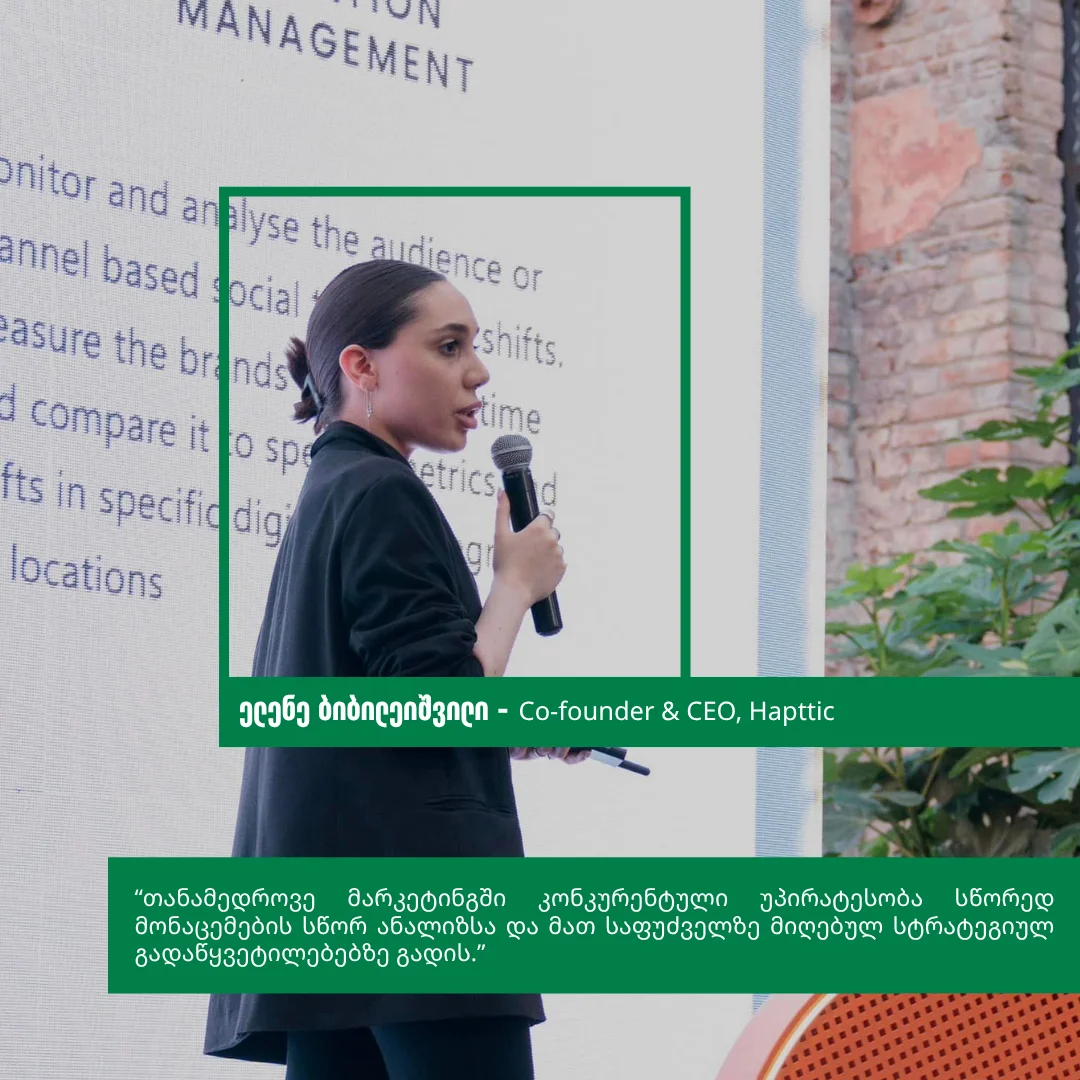
In one project, for example, a brand was focusing on specific keywords, while research showed that consumers were searching for the exact same product using entirely different terms.
Consumer attention has become one of the most valuable resources today. Businesses no longer have the luxury of making decisions based purely on instinct. In modern marketing, competitive advantage comes from properly analyzing data and building strategic decisions on top of those insights.”
what kind of data are companies looking for?
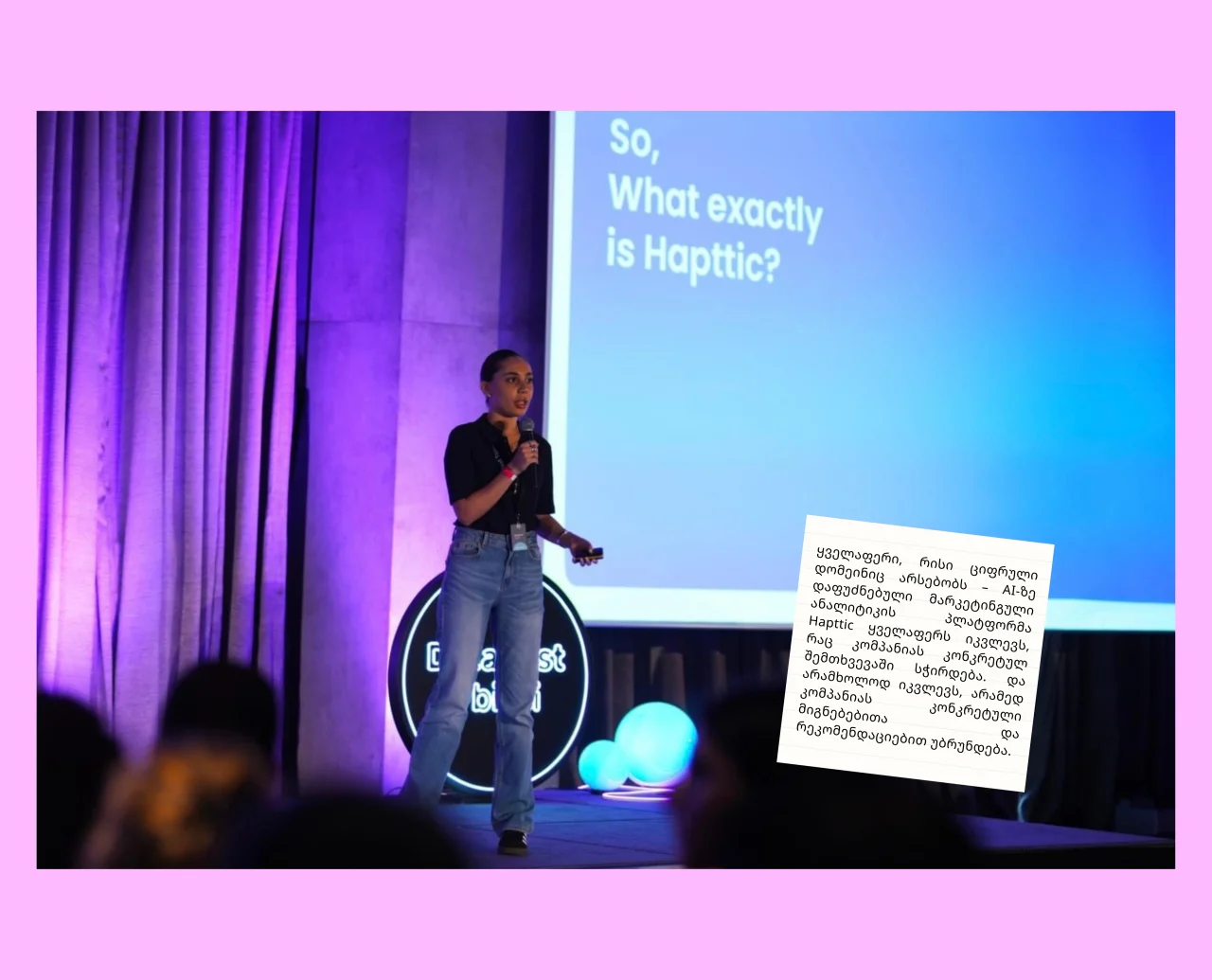
Whether it’s a one-time study or long-term monitoring, a specific time period, social media channels, websites, forums, AI platforms — essentially any digital domain that exists — Hapttic’s AI-powered marketing analytics platform can analyze whatever a company needs in a given situation.
And it doesn’t just conduct research. It centralizes all marketing data into a single system and returns it to companies in the form of insights and recommendations.
According to Elene Bibileishvili, businesses most frequently approach Hapttic with three core needs: competitor analysis, negative sentiment monitoring, and speed of data delivery.
Let’s break down some of these services further.
from campaign analysis to inbox intelligence
Content analysis is primarily used in campaign evaluation. Companies specify a time period, channels, and posts. Artificial intelligence then analyzes comments, and if competitor channels are included, the platform can conduct cross-analysis — comparing campaign performance, audience reactions, and engagement patterns across brands.
The system then generates findings and recommendations.
Take telecom companies as an example: if users repeatedly complain in a competitor’s comment section about a one-day unlimited internet package, that insight could become a strategic opportunity for another brand to introduce longer-duration packages.
Beyond social media and websites, Hapttic can also pull data from internal communication platforms, enabling inbox analysis. Businesses can track how many messages they receive daily, what customers ask most frequently, and how effectively operators respond.
Hotels, for example, actively use inbox analysis because booking inquiries often happen directly through direct messages.
Sentiment analysis is another highly requested service. As Elene explains, businesses are particularly interested in identifying negative feedback quickly:
“The sooner a business identifies a problem, the faster it can solve it. That’s why demand is growing not only for data itself, but for speed. Artificial intelligence allows us to automate a large part of the research process — turning one month of work into one hour.”
the future of traditional research
The moment when AI research fully replaces traditional research may not be too far away. Today, however, both approaches still coexist.
Which naturally raises the question: how reliable is AI-powered research?
Elene Bibileishvili, Co-Founder and CEO of Hapttic:
“There’s still skepticism around AI, and we’re often asked about error margins and the level of human involvement. Today, our system operates with 97–98% accuracy. It understands humor, sarcasm, and irony as well.
At the same time, for maximum precision, our support team remains in constant contact with clients. Every company has a dedicated manager who reviews the information before reports are delivered.”
According to Elene, AI already handles quantitative research exceptionally well — as long as it has enough information and the right context.
At the moment, Hapttic is developing a separate market research module powered entirely by AI, designed to minimize human involvement in the research process even further.
She shares one example:
“A company was developing an app for online doctor consultations. They wanted to understand the telemedicine landscape: what concerns users had, what questions they asked, which pharmacies they preferred, and how they searched for recommendations.
We conducted 200 monitoring and research campaigns, searched through 1,500 keywords, and processed more than 175,000 posts across the internet — all with minimal human involvement.”
Qualitative research, however, still requires a strong human element. Interviews and focus groups demand deep emotional and contextual understanding. But even here, it’s not impossible to imagine a future where AI becomes part of that process as well.
conclusion
Marketing research is one of the key prerequisites for business success. Brands that actively use it will almost always stay several steps ahead.
During the interview, Elene mentioned numerous companies already using Hapttic’s services, which suggests that the state of marketing research is genuinely improving.
At the end of our conversation, we asked her what she would say to companies still operating without research.
Elene Bibileishvili, Co-Founder and CEO of Hapttic:
“Many businesses still look at the market with their eyes closed. They may have a strong product and believe their campaigns are effective, but if they’re not listening to the audience’s real needs
and behaviors, they will eventually drift away from market demand.
In my opinion, the most important capability in modern business is data-driven thinking — the ability to make decisions not on assumptions, but on real customer behavior, feedback, and market analysis.”
And from our side, we’ll add one more thing:
Research — and optimizing the research process itself — ultimately creates more time for strategy and creative thinking.
Which means we’ll all have more meaningful and more interesting work ahead of us.