
the marketing power of sports commentators
behind the microphone:
written by: mariam mazanashvili
“He’s going to see it, he’s going to see it” — a phrase by Giga Gventsadze that has already become part of history. Or the voice of Kote Makharadze, describing Dinamo Tbilisi’s victory in 1981: “I can imagine what is happening in Tbilisi now — the capital is celebrating! The whole country is celebrating!”
In sport, the core product is emotion — and commentators are its first communicators. Their voice defines how a fan will remember a moment, a match, and even the sport itself. This article looks behind the microphone — at the people who shape the sporting experience, embed it into memory, and build emotional connections that remain one of the most valuable assets in sports marketing.
We spoke with commentators from two very different sports to explore their roles from multiple angles: from football — Aleksandre Gabrichidze and Nikoloz Tabatadze, and from Formula 1 — Levan Miminoshvili and Paata Papiashvili.
why commentators play a critical role in modern sport
In the digital era, the role of commentators has evolved alongside sport itself. They have stepped out from behind the scenes and become active participants in shows, broadcasts, and digital content ecosystems.
Today, many commentators independently build audiences and develop strong personal brands — across social media, YouTube, and other platforms. As a result, their profession extends far beyond the voice behind the microphone.
Nikoloz Tabatadze (football commentator, sports journalist, Setanta Sports):

“I think the commentator is a very important medium — a bridge between the viewer and the event they are watching.”
Often, it is the commentator’s style, tone, and perspective that influences a viewer’s choice of channel.
Aleksandre Gabrichidze (football commentator, Setanta Sports):
“In Georgia, the roles of commentators are often blended, and we have to take on multiple functions — something less common in more developed markets. For example, in England, a commentator is primarily focused on commentary — their face is rarely shown, and they are not required to take on additional roles.
On one hand, this is due to a lack of talent in the Georgian market, and on the other, because commentary requires immense effort and deep knowledge of football.”
The role of commentators becomes even more critical in technical sports like Formula 1, where the task goes beyond delivering emotion. They must translate complex sporting and technical details into clear, accessible narratives that keep the audience engaged and fully immersed.
Paata Papiashvili (Formula 1 commentator, Setanta Sports):
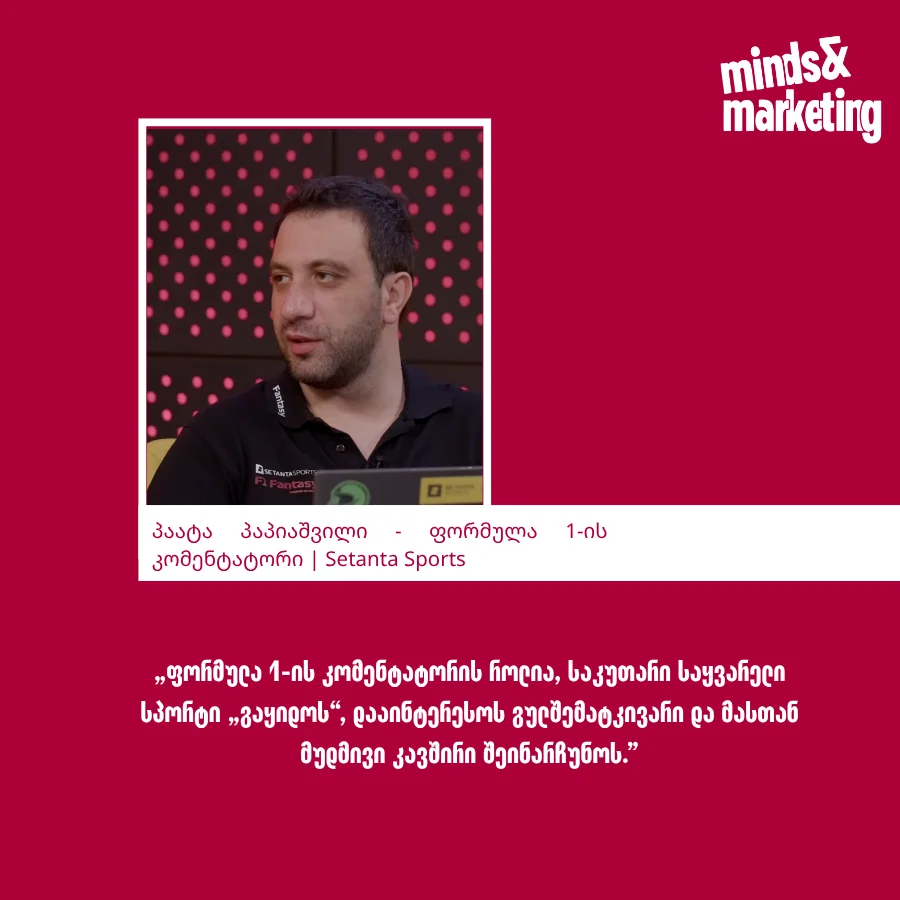
“I would compare Formula 1 commentators to drivers. Take Lewis Hamilton, for example — he is highly active off the track and plays a major role in promoting the sport. Commentators should be the same — they shouldn’t be limited to just commentary.
Their role is to ‘sell’ the sport they love, engage fans, and maintain continuous connection with them.
A good commentator is the combination of all this — their work shouldn’t end when the race finishes. On the contrary, they should continue communicating and interacting with fans even after.”
the art of delivering emotion
Years later, we often remember a specific goal or sporting moment not only visually, but through the commentator’s voice. That voice becomes the layer that amplifies the moment and transforms it into history. But what makes it iconic — the moment, the voice, or the perfect alignment of both?
Nikoloz Tabatadze (football commentator, sports journalist, Setanta Sports):
“Luck plays a very important role — if the right moment finds you, your voice automatically becomes part of that story. A phrase can become iconic, but our role is secondary. If the moment, the event, or the player doesn’t support it, even the most brilliant call might never be used. Timing is everything.”
In Formula 1, commentary operates differently — emotion alone is not enough. The commentator must deliver knowledge in real time, balancing adrenaline, emotion, and technical detail to create an experience that is both engaging and understandable.
Levan Miminoshvili (Formula 1 commentator, Setanta Sports):
“I believe a Formula 1 commentator should sit in the car with the drivers and deliver the emotion they feel in that exact moment. That’s our approach — Paata and I are essentially the ‘12th team’ this year.
Imagine driving at 300 km/h with Max Verstappen attacking from behind — what would you feel? That’s exactly what you need to communicate — accurately, authentically, without exaggeration.”
Formula 1 is one of the fastest-evolving sports, where missing a detail is easy. This is why commentators must constantly balance information, ensuring that viewers are left with no unanswered questions during the race.
On top of that, there is the constant need for objectivity. Commentators may cover matches involving their favorite teams — making emotional control and professional balance even more critical.
what happens when the game is boring?
Today, sport is no longer just a game — it is part of the entertainment industry, packaged and presented as a show. But not every match delivers spectacle. This is where the commentator’s role becomes even more visible — as someone who effectively “packages” the product and creates additional value.
Aleksandre Gabrichidze (football commentator, Setanta Sports):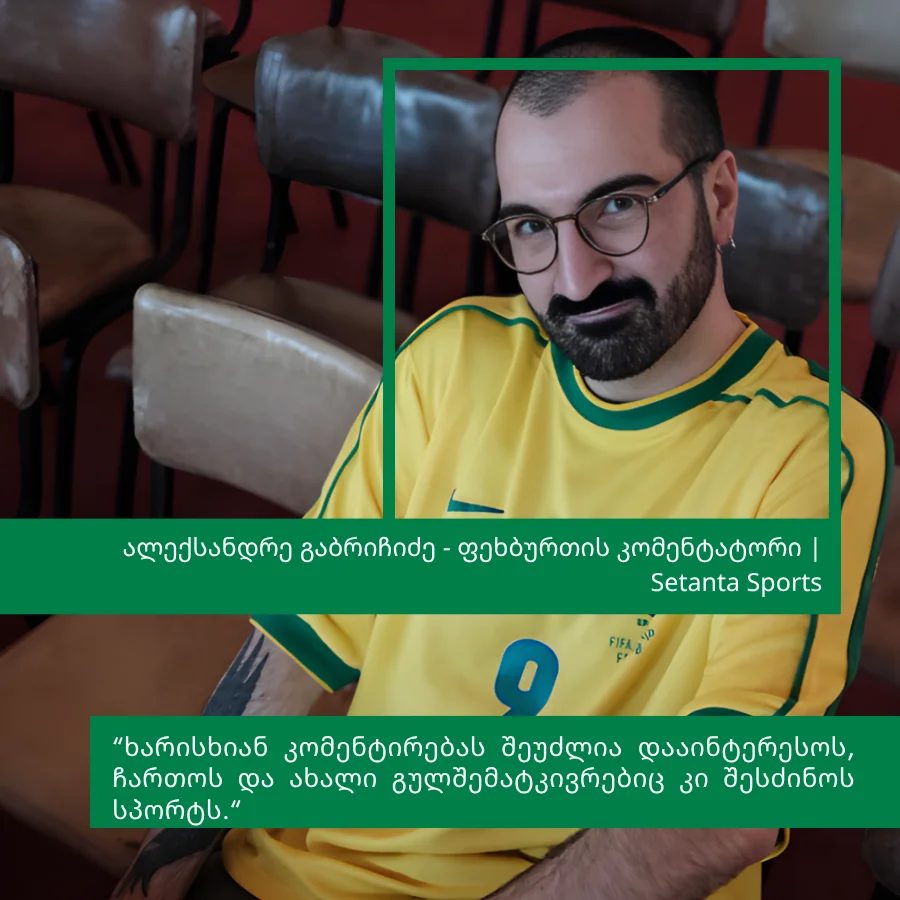
“A commentator is obliged to deliver their maximum performance in every match. They must be honest — if the game is boring, they should acknowledge it — but at the same time do everything possible to keep the viewer engaged.
Bad commentary can make hundreds of people perceive football as a less appealing sport, while high-quality commentary can do the opposite — attract, engage, and even create new fans.”
Paata Papiashvili (Formula 1 commentator, Setanta Sports):
“We have a privilege that drivers don’t — we can see more information during the race. Delivering that to the viewer is extremely important.
There may be races where nothing interesting happens, but that’s when the commentator plays an even bigger role — keeping the viewer in front of the screen.”
the personal brand of commentators — what happens beyond the microphone
Blogs, podcasts, interviews, YouTube content — today, commentators are everywhere. But is this transformation driven by industry demand, or is it part of a deliberate personal branding strategy?
Nikoloz Tabatadze (football commentator, sports journalist, Setanta Sports):
“I think there is a lack of sports publicism in Georgia. I wanted to strengthen this direction locally and express my love for football through words.
As for video content, it is partly the result of industry demand, including Setanta Sports’ strategy. It is important for commentators to be not just a voice, but also visually recognizable — someone fans can see in different environments.”
Aleksandre Gabrichidze (football commentator, Setanta Sports):
“I prefer to appear as little as possible and keep my role limited to commentary. However, I understand that there is a shortage of people who can speak about football — who want to, and who can do it well.
So I see my role partly as making the audience interested enough — through commentary or other formats — that in the future more people grow into these roles, and responsibilities become more clearly defined.
Ideally, a commentator should remain a commentator, and show participants should be hosts — these are fundamentally different skill sets.”
As we see, even within the profession, perspectives on the commentator’s role differ — which became one of the most interesting insights of our research.
Levan Miminoshvili (Formula 1 commentator, Setanta Sports):
“We actually started with a Facebook group before becoming commentators. We were active, running competitions, trying to spread the word that this sport exists.”
the evolution of the profession — what comes next?
In the age of artificial intelligence, the question of replacement is everywhere. But does it apply to sports commentators?
While AI is already integrated into many professional fields, its role in commentary remains limited and cautious. As our interviews suggest, AI can serve as a supportive tool — helping structure information — but relying on it fully in live commentary is still challenging.
This is why commentators continue to prioritize direct sources — independently verifying statistics, materials, and data.
Nikoloz Tabatadze (football commentator, sports journalist, Setanta Sports):
“I don’t think fully ‘artificializing’ this process will lead to good results. If we talk about emotional connection — which is fundamental in football — an artificial, structured voice cannot replicate the feeling of live commentary. At this stage, I don’t see real integration of AI into pure commentary.”
Sport in the digital era is constantly evolving — but one thing remains unchanged: emotion.
And the medium of that emotion is voice — the one that gives meaning to the moment, intensifies it, and ultimately turns it into history.
The role of the commentator is far broader than simply narrating a game. They are simultaneously storytellers, analysts, content creators, and part of the brand itself.
This is where their importance in sports marketing becomes clear — commentators build emotional connections that drive engagement, strengthen brands, and shape fan loyalty.
Technology may change many things, but as long as sport is built on emotion, the commentator will remain at its center.