
the arveladze brothers on the london stock exchange, iphone 18, and back-to-school campaigns
september focus
September is usually dominated by back-to-school campaigns. Brands tend to build their communication around new beginnings, returning to work, returning to school, and getting back into a familiar routine.
This September was no exception. Still, some of the most interesting campaigns had little to do with back to school at all.
zoommer x supermarket - teachers can’t wait
Zoommer frequently brings its brand platform - “when you can’t wait” - to life through different campaigns. Its September campaign followed the same idea, this time from a teacher’s perspective: “teachers can’t wait.”

It also reflects a creative approach that has become increasingly visible in Supermarket’s work this year - taking a familiar theme and showing it through someone else’s eyes. A back-to-school campaign is told from the teacher’s perspective. A March 3 and March 8 campaign focuses not on mothers, but on grandmothers in “every grandmother is the best in the world”. And for May 26, instead of looking back at historical heroes, the focus shifts toward the next generation in “the future doesn’t stop, the future is coming”.
Back to the latest campaign.
In the film, a teacher - or, as the familiar expression puts it, “a parent to 1,000 children” - gets out of bed impatiently and prepares to see her students, accompanied by Jansug Kakhidze’s “March.” She eventually joins the children, dances with them, and heads to school.
Through the video, Zoommer and Supermarket position the teacher as someone who genuinely cannot wait for school to begin and to see her students again. Even while at home, she is still thinking about them - something reinforced by the children appearing around her as she goes through everyday household routines.
I went through the comments, and the overall response seemed largely positive. At the same time, another interpretation emerged. For some viewers, the march-like music, synchronized movement, and orderly walking created associations with a kind of “Soviet discipline.” This was almost certainly not the intended message, but it is still an interesting example of how visual and musical cues can produce meanings beyond a brand’s original intention.
Many teachers also shared the video themselves, adding emotional personal captions. That is perhaps the clearest sign that the central message reached the audience it was meant for. The campaign did not end with the hero film. Zoommer also published several videos featuring real teachers speaking openly about what school means to them and what it feels like to return to their students.
alta - treat yourself
Throughout September, Alta kept repeating one message: “September is your new year.” That idea became the foundation for the campaign’s call to action - “treat yourself.” The concept was mainly developed through graphic posts and reels, with most of the communication focusing on discounts across different technology products.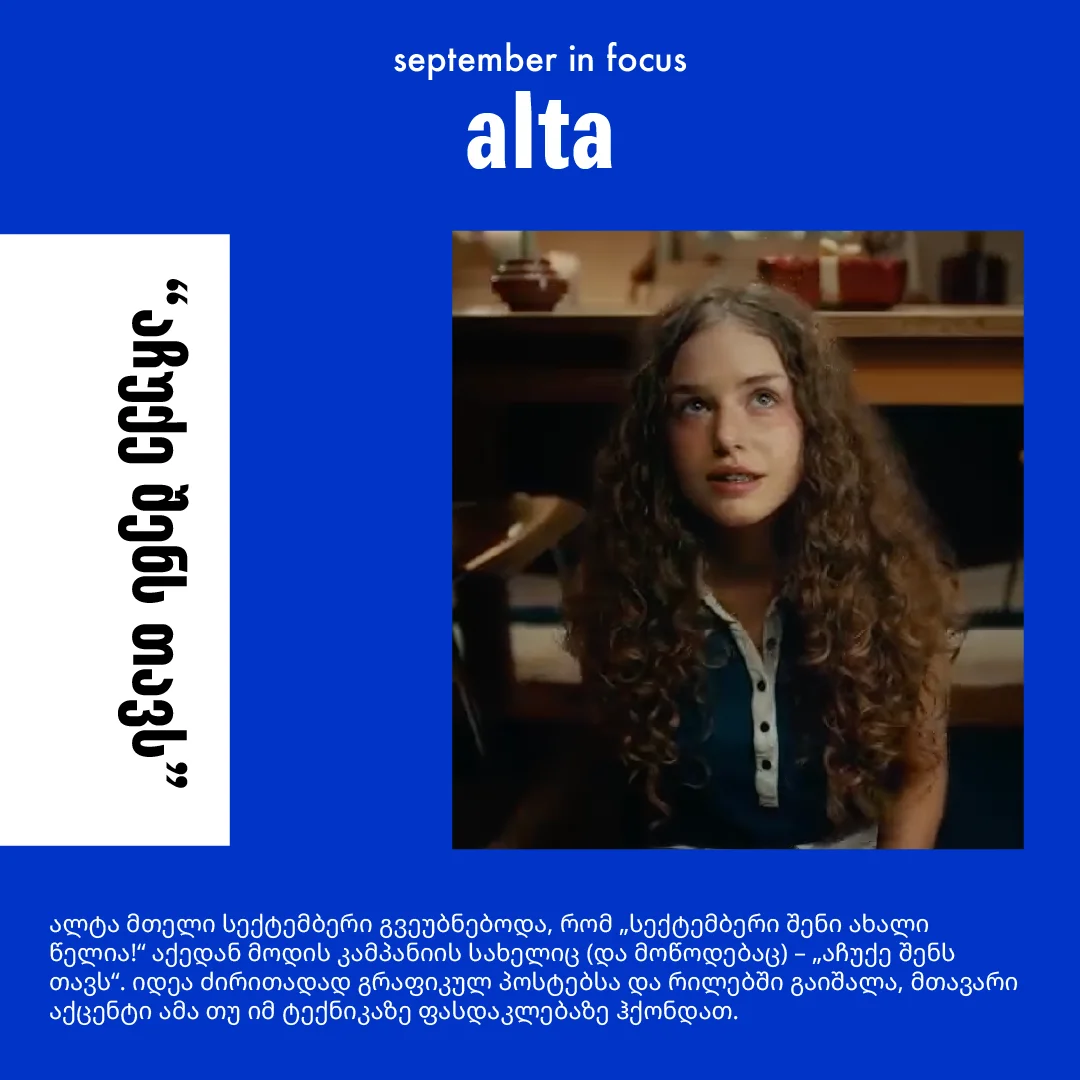
The underlying insight - that September feels like a new year for many people - is strong. But I was left with the impression that the idea was not developed as fully in the communication as it could have been.
For many people, September genuinely represents a new beginning. In that context, “treat yourself” could have become an invitation to invest in personal development, with technology positioned as the tool that helps make that change possible. A laptop could represent learning something new. A camera could enable a new hobby, creative direction, or profession.
What seemed to be missing was a clear connection between the emotional idea of a new beginning and the individual products being promoted. What exactly are you giving yourself through this purchase - more time, a new opportunity, new knowledge, or the motivation to start something different? Building that connection would have given the campaign more depth and made it easier for audiences to connect the products to their own lives.
When the dominant focus remains on discounts, the emotional foundation becomes less visible, and “September is your new year” risks remaining simply a strong line rather than becoming a fully developed campaign idea.
tbc x holy motors x katsebi x the arveladze brothers - investing on the london stock exchange
Legendary Sherlock Holmes, British humour, Georgian references, a script by Kacebi, the Arveladze brothers, and production by Holy Motors - TBC used a series of short films to communicate one simple message: “Investing on the London Stock Exchange is now elementary.”
Much like the original Sherlock Holmes stories, each episode has its own plot: “Sherlock Holmes and the London Stock Exchange”, “Sherlock Holmes and the Perfect Gift”, “Sherlock Holmes and the Crossword Mystery”, and “Sherlock Holmes and the Unexpected Guest”. Shota and Archil Arveladze take on the roles of Sherlock Holmes and Dr. Watson, while Temur Ketsbaia appears in the final episode. 
The campaign’s strongest strategic idea lies in the connection between the product and the characters. The London Stock Exchange fits naturally into Arthur Conan Doyle’s world, while the word “elementary” works on two levels - it recalls Sherlock Holmes’ most recognisable expression while simultaneously communicating the simplicity of investing.
For many people, investing still feels complex, technical, and inaccessible. By explaining it through humour, the campaign lowers that psychological barrier. The audience first encounters two familiar and well-liked public figures playing equally familiar fictional characters. That positive recognition then continues through humour, while product information is woven naturally into the jokes. The result is that the common mental barrier - “investing is difficult, I won’t understand it, I don’t know how it works” - becomes easier to challenge.
The combination of a British setting with distinctly Georgian references makes the campaign feel closer to the local audience. “10 pounds and another shilling,” “Faradaiz,” a coin attached to a string for the telephone box - these details feel deliberately out of place in a traditionally British environment, and that contrast becomes part of the humour.
If the goal was the one I took away from the campaign, then it worked: we understood that the London Stock Exchange is now available through TBC Mobile Bank, and we also understood that investing is, apparently, “elementary.”
zoommer x supermarket - where was the iphone?
Zoommer had barely wrapped up its teacher campaign when it launched another one around the new iPhone - “where was the iPhone?” The humorous video takes aim at a very familiar form of toxic social behaviour - people feeling the need to judge, question, or criticise someone else for buying an iPhone. “Where was the iPhone when we used to fold our phones into our pockets?” “Where was the iPhone when phones charged without cables?” And so, “wherever it was before,” iPhone 18 is now at Zoommer.
Using recognisable social behaviour as the starting point for creative work is something Supermarket has done effectively before. Zoommer’s youthful, playful, and contemporary brand character also gives this kind of satire a natural space to work. The brand can speak to its audience using the same language and observations people encounter in everyday life.
Buying an iPhone often becomes more than simply choosing a piece of technology. It becomes something other people feel entitled to comment on. Why did you buy it? Do you really need it? Wouldn’t another phone have been better?
The video turns those unsolicited opinions - and the habit of judging someone else’s choice through your own experience - into the source of humour. Zoommer, meanwhile, positions itself on the side of the customer, leaving people free to make their own choices without needing to justify them.
in summary
What makes these campaigns interesting is the way brands connect their message to feelings and behaviours their audiences already recognise - a teacher’s anticipation, the desire for a fresh start, anxiety around investing, or the habit of interfering in other people’s choices.
In some cases, these insights strengthen an existing brand platform. In others, they help audiences feel closer to a specific product.
The shared lesson is simple:
A strong insight is only the beginning of a campaign.
The next step is turning that insight into communication and connecting it meaningfully to the brand or product.
Only then does a familiar emotion, tension, or behaviour become a story in which audiences can recognise themselves - while also understanding what the brand actually wants to say.