
strategy and strategists - what’s the challenges?
globally and in georgia
Today, it’s widely accepted that marketing and creative solutions are essential. Every day, new brands and agencies emerge; we watch their campaigns, analyze their communication, and discuss their impact. From the outside, it all looks colorful and impressive. But what lies beneath? How strategic are the foundations of Georgian brands? Is there a strategic backbone that supports every decision they make? It’s time to talk about it.
What’s Wrong with Strategy Today? – Global Trends
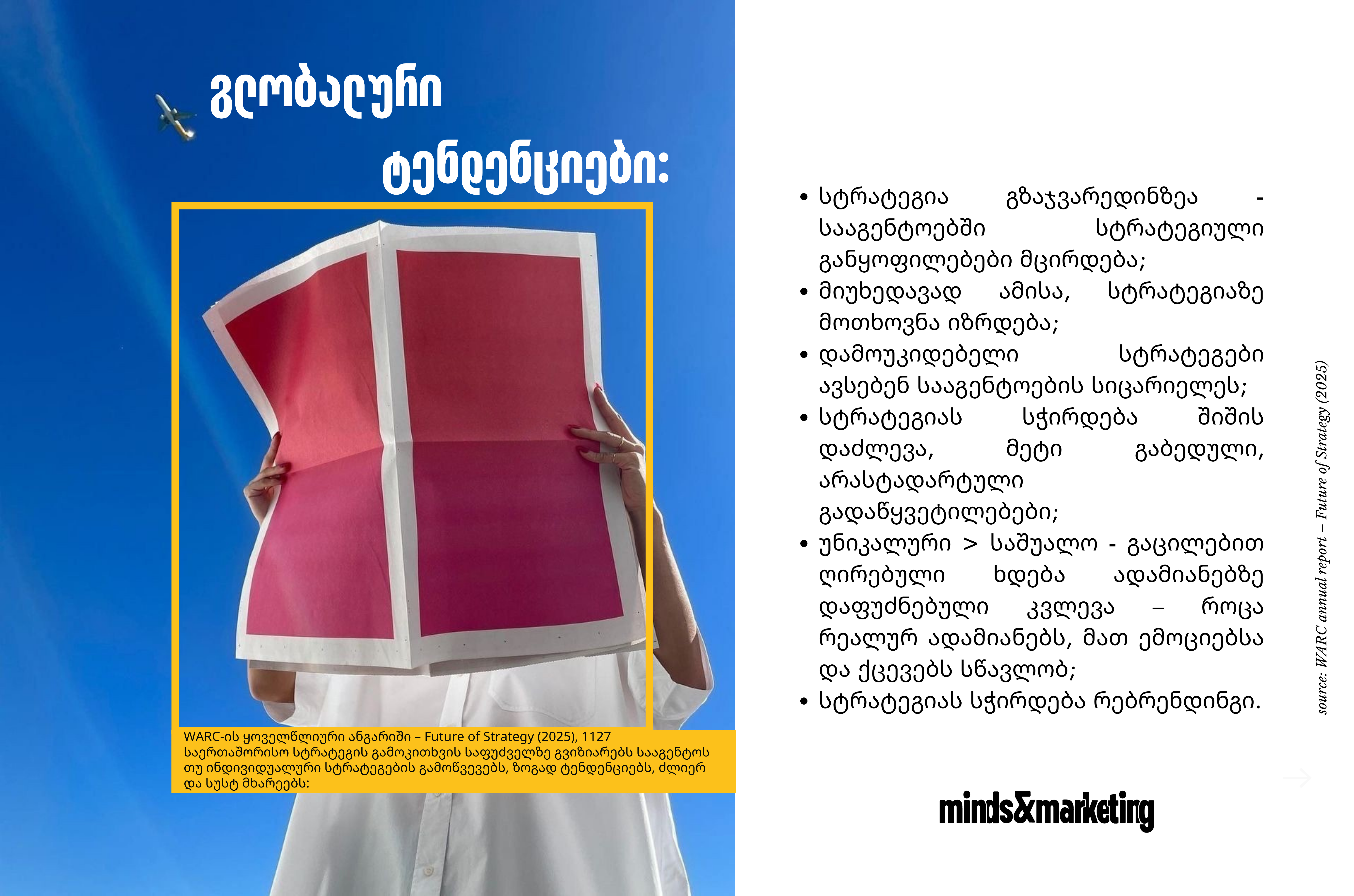
A few weeks ago, I read WARC’s annual report “Future of Strategy 2025”, based on insights from 1,127 strategists worldwide. The report explores the challenges, trends, and strengths and weaknesses faced by strategists working both in agencies and independently.
Reading it brought me mixed feelings: on one hand, relief – because the challenges I often face while working with brands aren’t unique to Georgia, but part of a global trend. On the other hand, it reaffirmed that strategy as a discipline is undergoing a complex transition everywhere.
Here are some of WARC’s key findings:
- Strategy is at a crossroads
Most strategists believe the field has reached a critical turning point. To stay relevant, strategy must adapt. Yet, many organizations still perceive it as non-essential – an extra cost.
Across agencies, strategic departments are shrinking, weakening the overall strategic structure. - Despite this, demand for strategy is growing
In today’s unstable environment, brands need clear strategic thinking more than ever. Paradoxically, while strategic roles inside agencies are losing priority, the demand for strategic expertise continues to rise. - Independent strategists are filling the gap
As agencies downsize their strategy departments, more organizations turn to freelance and independent strategists, who often deliver work equal in quality – or even superior – to traditional agency setups. - Strategy needs fewer ‘safe’ and more ‘brilliant’ decisions
One of the greatest risks to the industry, strategists say, is the fear of risk itself. It leads to safe, predictable, and – ultimately – boring results.
Transformational strategy begins when a strategist dares to break patterns, think unconventionally, and do what others are afraid to attempt. - Views on AI are divided
Some strategists don’t believe artificial intelligence threatens their value, but most admit that the risk is real. Because AI operates within existing frameworks, the only way for strategy to survive is to think beyond those frameworks – to remain creative, human, and non-linear. - Unique beats average
When most companies use the same datasets and publicly available statistics, the real differentiator becomes human-led research – the ability to study real people, their emotions, and their behavior.
That’s what helps brands stand out, instead of becoming just another average name in the crowd. - The role of strategic departments needs rebranding
Agency strategy teams must reposition themselves – not as internal analytical units, but as growth-oriented partners that simplify complexity, create systems, and enable long-term business success.
These findings reaffirmed what I’ve long suspected: If even international strategists face such challenges, the situation in Georgia is unlikely to be ideal.
So I decided to dig deeper – to speak with exsisting Georgian strategists, to ask questions, and to understand what’s really happening here.
Research Objectives

The study aimed to uncover:
- How well the concept and role of brand strategy are understood in the Georgian marketing ecosystem.
- What challenges and opportunities Georgian strategists currently face.
- What can be done to transform brand strategy in Georgia from a “nice-to-have” document into a must-have business foundation.
minds&marketing’s goal is to spark an open discussion: What’s holding our field back? What challenges do strategists encounter? And how can we collectively do better? There’s a lot to talk about – and even more to share.
Methodology
In October 2025, 10 Georgian strategists participated in an online survey. Some of them work at agencies, others independently, and some represent specific brands. In addition, two in-depth interviews were conducted.
The study used a qualitative methodology, aiming to explore participants’ perspectives, experiences, and insights to build a complete picture of where we stand today – and where we could be tomorrow.
Before diving into the findings, let’s first clarify one essential question.
What is Brand Strategy?
Brand strategy is the spine of a business – a solid foundation that defines why the brand exists, what it stands for, what value it brings to people, and how it should be perceived.
It is a long-term vision that connects the brand’s purpose to its business objectives.
Twenty years ago, businesses dictated the rules to brands. Today, that relationship has reversed: brands now guide how businesses evolve and express themselves.
A common misconception is that brand strategy is merely a document used by the marketing department. In reality, it’s a parallel roadmap to business strategy – one that every department should follow.
A comprehensive brand strategy defines:
- The brand’s mission, vision, purpose, values, and role;
- Its target audience and value proposition;
- Its positioning, personality, and communication style;
- Strategic directions, decisions, and tactics that ensure two key things:
1. Consistent perception in the consumer’s mind;
2. Cohesive navigation across the organization to achieve its goals.
Why do We Need Brand Strategy?
Because strategy turns noise into meaning, campaigns into impact, and brands into experiences.
In a time when clarity and consistency are critical, brand strategy creates order out of chaos.
It gives direction and anchors daily decisions to a clear purpose.
Understood – brand strategy is good, but…
What Challenges do Georgian strategists face today?
The findings of this research clearly show that if, globally, strategy stands at a crossroads and is evolving in new directions, in Georgia it is still searching for its rightful place.
While more and more businesses – not only large but also medium-sized – are beginning to recognize its importance, there’s still a strong need to raise awareness about its value and purpose, and to allocate appropriate resources to it.
From discussions with local strategists, several key challenges have emerged – challenges that must be addressed for strategy to progress both individually and organizationally.
Here are the key findings from our research:
- Awareness of strategy is low
We lack a clear understanding of what brand strategy truly is – its meaning, role, and necessity. Most surveyed strategists agreed that:- Brand strategy is often confused with a marketing campaign or a creative idea;
- Its impact on business results is poorly understood;
- It’s seen as “nice to have” rather than a must-have foundation for business;
- Short-term performance marketing and quick results often overshadow strategic thinking.
- Lack of Qualification
Most respondents agreed that qualified brand strategists are scarce in Georgia.
Many believe that this is partly due to “juniorization” – a wave of newcomers entering the job market without sufficient theoretical or practical knowledge of strategy. - Lack of Educational Opportunities
Most participants highlighted that to prioritize and develop strategy as a discipline, education is key – the creation of academic programs that treat strategy as a distinct, knowledge-based field. - Weak Strategic Foundations of Georgian Brands
The majority of respondents believe that Georgian brands have weak or underdeveloped strategic foundations, which is naturally linked to the lack of education and qualified specialists. - Strategic Thinking in Local Brands Is Improving
Despite existing challenges, most respondents note that strategic thinking among Georgian brands is improving. - Demand for Strategy Is Declining
Paradoxically, while strategic thinking is improving, demand for strategy projects has decreased or stagnated over the past 12 months.
Only one respondent mentioned that demand at their agency was growing.
The forecast for the next year is not too optimistic either – most respondents expect demand to either remain unchanged or decline.
Here, a gap becomes evident: businesses are starting to value strategic thinking, yet are not actively investing in it. - Lack (or Absence) of Budgets
Most participants noted that one of the major issues is the lack of allocated budgets for strategic work – again, tied to low awareness.
If key decision-makers truly understood that strategy is essential for business growth, funds would be found. - The Country’s Socioeconomic Context
Naturally, Georgia’s current political, social, and economic instability affects brands, pushing them to focus on short-term campaigns that bring immediate results rather than long-term strategies.
However, paradoxically, the more unstable the environment, the more vital it is for a brand to remain stable – to withstand challenges and navigate uncertainty.
Overall, while the situation around brand strategy in Georgia is full of challenges, there is visible progress — the industry is gradually evolving year after year.
To ensure this progress continues and that businesses clearly understand the value of strategy, certain changes are essential.
Below are recommendations developed through local and international experience.
Recommendations
- There’s a need to build greater awareness.
If, as WARC’s report suggests, strategic departments in agencies globally need rebranding, in our case, strategy itself needs branding. Awareness must grow – especially on the business side – about what brand strategy is and why it’s essential. Company management must believe that for a business to become a brand, it needs strategy.
Strategists should talk more openly about their work – not just share outcomes, but also the process: real cases, behind-the-scenes insights, full project cycles.
The focus should shift to why strategy matters and how it contributes to business success.
Currently, creative campaigns and social media communications are well understood as business needs.
Now, it’s time to make brand strategy equally clear and non-negotiable – something management actively demands from marketing departments. Only then will it matter less whether strategy is developed internally or by external experts – what matters is that it exists. - Businesses Must Be Active Participants, Not Just Clients
Both sides must understand the value of collaboration. Management should be fully involved in the strategy creation process – to provide the strategist with information and ensure readiness to implement every element of the plan.
Strategists, in turn, must convince businesses that a well-crafted strategy drives business success. This requires setting clear KPIs, tracking outcomes, and linking them to tangible results.
Here lies the strategist’s real role:-
- Help businesses appreciate the long-term value of strategic marketing (vs. short-term performance outcomes);
- Encourage management to think more creatively and break out of “safe thinking.”
-
- Strategists’ Qualifications Must Improve Younger professionals are entering the field rapidly but often lack theoretical grounding. Since many businesses already view strategy with skepticism, an unqualified strategist can harm the entire discipline’s reputation.
That’s why strategic education and professional standards are crucial – whether developed through universities, academies, or within the industry itself. We need a clear definition of what it means to be a strategist – the responsibilities and competencies required. - Don’t Cut Corners on Strategy Budgets
Many business leaders still view strategy as an unnecessary expense, rather than a long-term investment. It’s the strategist’s job to change that perception.
Simply put — saving money on strategy doesn’t pay off. But before that can happen, the value of strategy must be clearly communicated – awareness comes first, budget follows.
Summary
Although one of the in-depth interviews painted a very optimistic picture – with high awareness and growing demand – the overall reality is still mixed.
Despite some progress, many challenges remain. While the global conversation focuses on strengthening strategy’s role, we are still proving its necessity.
If Georgia’s creative industry wants to evolve to the next level, we must invest more energy into positioning strategy not as a formality, but as a core process – the backbone of every business.
Naturally, the recommendations outlined here are not full solutions – large-scale, systematic efforts are required.
But identifying the problems and opening up the discussion is an important first step.
And that’s precisely the goal of this article – to create a space for dialogue, to talk more, to understand what challenges us – and what inspires us.
There’s still plenty to discuss, and plenty of work ahead.
You can find the research finding at the link.