personal branding during relocation
people, strategy, influence
written by: eko chubinidze
Think about one word your business partners, colleagues, or clients would use to describe you — if we asked them right now.
Then think about how you would describe yourself in your professional role. Limit it to one or two words. For deeper insight, you can even run a small experiment and ask a few people directly.
Do these perceptions match? How closely do these words reflect what you want and how you see yourself?
Personal brands have always existed around us — across different forms, goals, and expressions. In Georgian culture, one of the most authentic versions is the idea of a “influental personality,” a concept still very much alive among older generations. Ask your parents or grandparents — who comes to mind first?
However, digital media, the rise of content creators, and the boom of freelancing have multiplied personal brands within our feeds, significantly accelerating this trend.
Today, the importance of personal branding is also becoming visible in corporate environments — especially at higher levels. As specialization and narrow expertise gradually lose their dominance, leadership is increasingly defined by perception: what people think about you, what it feels like to work with you, what values you represent, and what you strive toward as a leader.
The role of minds&marketing within this shift is to uncover its strategic dimension and involve the community in meaningful conversations around personal branding. In this editorial series, we explore and share:
- When personal branding becomes an added value;
- What role it plays in professional growth;
- How it develops when driven intuitively;
- How it develops when guided by strategy;
- And what key elements transform a personal brand into a strong and influential one.
when does personal branding become an added value?
It’s not new to say that anyone engaged in professional activity already has a personal brand—whether for investors, employers, clients, patients, followers, or students.
The more interesting question is: when does a person reach the stage in life where activating their personal brand becomes a necessary component of growth and advancement?
- Relocating to a new country
- Holding a senior corporate position
- Entrepreneurship
- Changing professions
- Independent professional / freelancing
Each of these situations comes with different goals and challenges—so the role and specificity of personal branding also shifts accordingly.
This editorial series will focus on these transitions. We will share real stories and explore why and how people build and activate their personal brands — or, in some cases, what holds them back.
Expect insightful, inspiring, and real narratives ahead.
relocation — moving to a new country and redefining professional identity
“Your work will reveal who you are.” Your actions, projects, successes, and failures shape how others perceive you. When you operate within the same industry or community for a long time, these perceptions naturally form — whether intentionally or not.
The real question is whether you like what you see as a result — and whether it aligns with your own vision.
But what happens when you leave that industry, community, country — or even continent — and move somewhere entirely new?
A place where your professional identity feels like a blank page — but not entirely blank.
This is where the strategic management of your personal brand becomes critical. On one side, you analyze your past experiences and identify patterns. On the other, you assess the new market and environment—building an authentic professional identity at the intersection of both.
Marita Genebashvili, Head of Investor Relations | Climatic:
“In Georgia, I was an entrepreneur, building innovative products. I lost that positioning when I moved to the United States.”
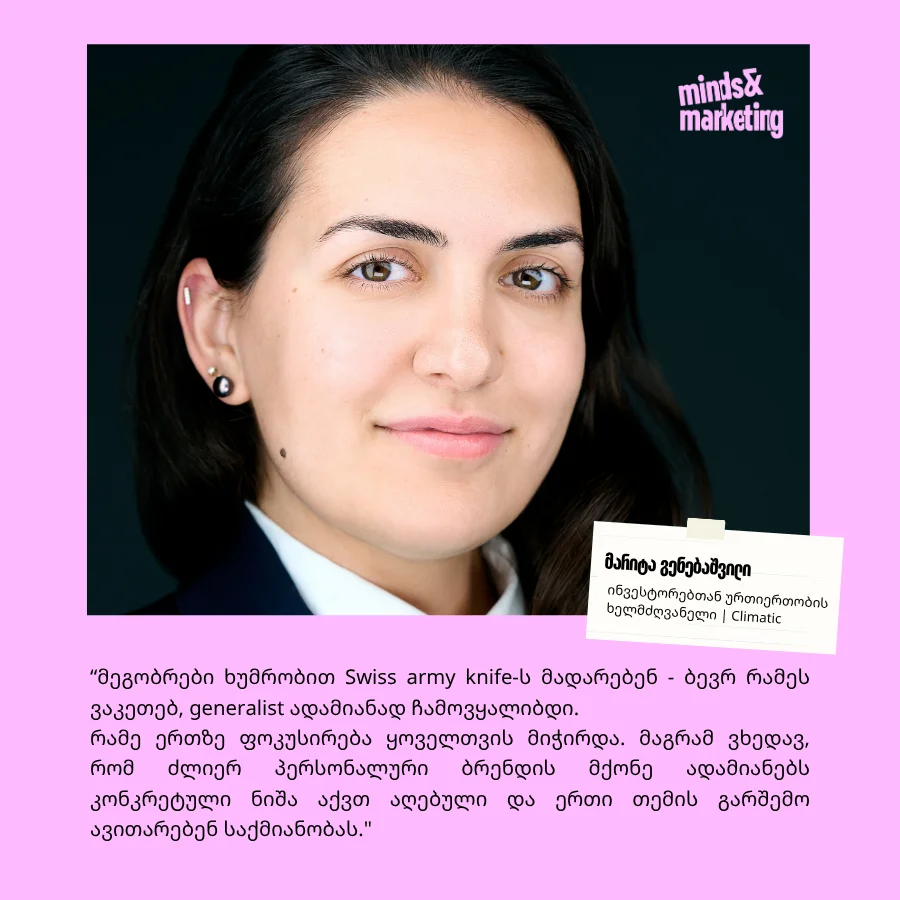
Four years ago, Marita relocated to Boston with her family, following her husband’s new job opportunity.
In Georgia, her experience included three successful innovative startups — one of them a charitable platform for children — alongside roles as a trainer and speaker, a strong network, and a clear positioning that consistently attracted meaningful opportunities.
In contrast, she entered one of the most competitive markets in the world with a different starting point. Although her startups continued to operate remotely, it became clear that the move to the U.S. was long-term — prompting her to actively invest in her professional development within this new context.
“I quickly realized that network is a critical asset here. I started building mine through volunteering, joining startup communities, working on multiple projects, and meeting many people. My current role came through a recommendation from someone I met at one of these events.”
Building a network — both digitally and through physical interactions — is one dimension. The other is how you position yourself within that network and what opportunities you pursue.
Marita shares that niche positioning was not initially her goal. Instead, it emerged organically through her activities and the opportunities that followed. Over time, she recognized this pattern and began to develop it more strategically — something clearly reflected in her LinkedIn content and community.
“Friends jokingly compare me to a Swiss Army knife — I’ve always done many different things and developed as a generalist. Focusing on one area was always difficult.
But I see that people with strong personal brands often own a specific niche and build around a single theme.
After my volunteer work, I joined an accelerator where I worked with around 200 climate tech startups and investors. That experience deepened my interest in the industry, and I realized it could shape my positioning. My current role is in the same space — only even more niche.”
An important part of Marita’s positioning is her role transformation. While she was an entrepreneur in Georgia, in her new environment she has become a startup–investor matchmaker — leveraging one of her most authentic and powerful strengths: relationship building. Such a major professional shift naturally comes with uncertainty and doubt. As Simon Sinek puts it: “When in doubt, be yourself.”
While this may sound simple, it requires both self-awareness and intentionality. When you actively manage the process and remain honest with yourself, you often discover strengths you may have previously underestimated — and begin to use them more consciously.
key insight
People turn to personal branding for two main reasons:
1. First, to gain clarity about their professional identity and the value they create;
2. Second, to communicate that value publicly — at a level of exposure that feels right for them.
During relocation, clarity becomes the priority.
If you are currently navigating this path, these insights can guide you:
- Positioning: The larger the market you enter, the more critical clear positioning becomes. To define it, consider:
What is your niche? While niche positioning can feel risky in smaller markets, in larger markets it is often safer — and full of opportunity due to scale.
What unique value do you create as a professional? Relocation is one of the best moments to rethink this. Beyond expertise, your personality plays a key role — this will be explored further in future articles.
What is your story — the narrative that supports and strengthens your positioning? This is what builds trust and authenticity.
What skills, products, or services are missing in the market that you can provide?
In which area do you have the potential to become the obvious choice?
- Talent: The things that “flow like water.”
This is where you need to develop respect for even your most effortless abilities. Often, what comes naturally to us goes unnoticed — because it doesn’t require effort. Yet these are precisely the skills that differentiate us and create unique value.
- As with everything, balance matters — between action and strategy.
Marita’s journey reflects both: intuitive action in the beginning, followed by observation of results and patterns — what came naturally, what required effort — and then strategic planning for future steps and goals.
in conclusion
Working on your personal brand during relocation is a process shaped by experimentation, self-discovery, and building new relationships.
The most valuable tool in this journey is positioning — the one sentence that clearly defines your niche, your audience, and the value you create.
This sentence becomes the foundation for building your network — and a magnet for new opportunities.
In the next article, we will explore the stories of entrepreneurs — examining when they need to activate their personal brand versus their startup brand, what risks and benefits come with it, and how to find the right balance between “me” and “my startup” at each stage of growth.