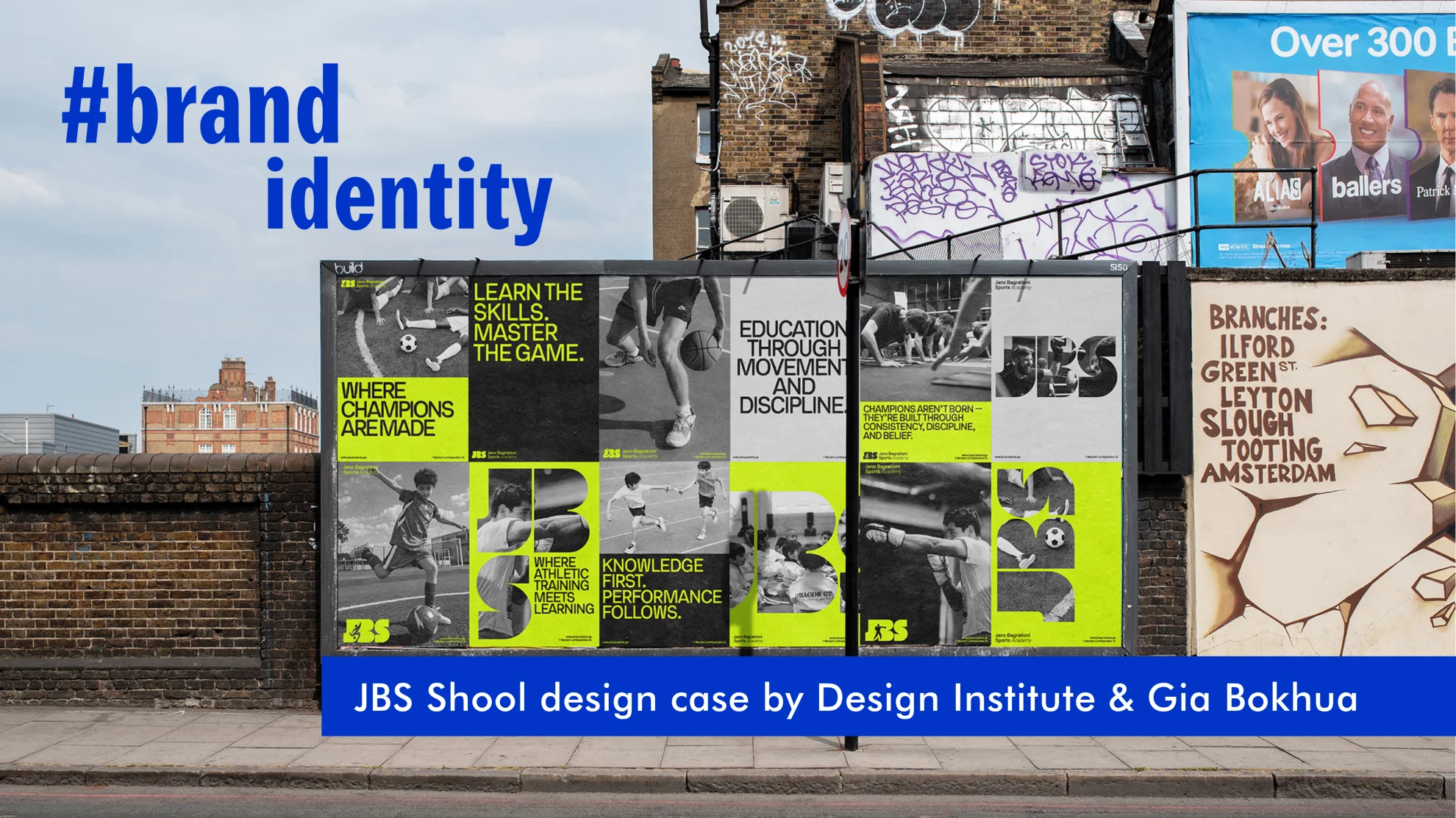
how design shapes ideology
not just a brand
Well-crafted design does more than build a brand’s visual identity. It lays the foundation for an ideology — one that influences how people behave, what they believe, how they think, and what they value.
When every visual detail of a brand not only reminds you of its name but also evokes emotion and tells a story, it signals something deeper: a narrative with intention behind it. This is exactly the kind of story we aim to unpack—how a brand comes alive through design, and how design, in turn, shapes ideology (not just a brand).
Today, we’re looking at how the Design Institute developed the visual identity of JBS — Jano Bagrationi School.
about the school
Before diving into how the concept translates visually, it’s important to understand the foundation.
JBS—the first educational space in the region inspired by the legacy of Jano Bagrationi — is also the first school in Georgia to introduce a holistic education model. Unlike traditional systems, this approach combines a strong academic program with age-appropriate athletic development, while also prioritizing everyday well-being and socially meaningful values.
Here, a child’s physical, emotional, and intellectual growth are equally critical to their personal development. The philosophy is clear: education should not prepare students for exams—it should prepare them for life.
the challenge
The Design Institute was tasked with solving several complex challenges:
- Visualizing the intangible — translating a concept that does not yet physically exist into a compelling visual system that communicates value and differentiation to both parents and children;
- Merging tradition with modernity — reflecting both the values of Jano Bagrationi and a contemporary educational mindset;
- Connecting three domains — academics, sports, and emotional well-being are traditionally seen as separate. Here, the visual identity needed to communicate their integration into a single ecosystem;
- Defining a new category — in a saturated education market, JBS needed to claim the position of the “first holistic school,” meaning the design had to create entirely new expectations and perceptions.
Ultimately, the goal was to transform the school’s ideology—balanced physical, emotional, and intellectual growth — into a strong, actionable brand. One that establishes a new benchmark in education while translating the Olympic values of a legendary Georgian athlete into a modern learning ecosystem.

understanding heritage and market insights
As Nino Egadze, Creative Lead at the Design Institute, explains, the process began with in-depth interviews with the founders—Irina Adeishvili and Levan Akhvlediani—to fully understand the historical legacy behind the brand.

As the analysis revealed, Jano Bagrationi’s name is not just a tribute — it’s a promise. A promise of discipline, resilience, and a “champion’s mindset” that seamlessly connects sports and academic excellence.
The ambition was to build a brand that prepares young people for leadership and fair competition — not only on the field, but in life.
Despite initial strategic assumptions, the team made a deliberate decision to pause and invest in market research, partnering with the research company Anova. This proved to be a critical move, as the findings reshaped the entire strategic direction.
The insight was clear: for parents, emotional safety and balance matter more than academic achievement alone.
This led to a fundamental shift in the brand archetype. JBS evolved into the “Mindful Achiever” — a personality that views challenges as opportunities for growth, and defines success not just as winning, but as self-awareness and alignment with one’s values.
visual identity
Designer Gia Bokhua was tasked with translating this strategy into a visual identity that is energetic yet academic, trend-aware yet consistent—and most importantly, capable of expressing the brand promise: “We raise winners in the game of life.”
structure
The strategic framework of the brand is built on the expertise of international education specialist Troy Fillman, who developed the school’s comprehensive program and model. This resulted in the 5R system:
• Responsibility
• Resilience
• Relationships
• Reflection
• Relentless Effort
From a design perspective, this meant creating a visual language rooted in discipline, growth, and balance. Every element needed to connect to a system that strengthens individuals through structure; to a mindset that builds both body and character; and to an ambition driven by joy rather than pressure.
As Gia Bokhua explains:
“The JBS Academy logo is built around a bold and massive JBS wordmark, giving the identity a strong and confident presence. At the same time, its volumetric letterforms allow for sports imagery to be embedded within them, turning the logo into a dynamic system rather than a static mark.
This approach adds versatility — the logo functions both as a clear standalone symbol and as a flexible graphic container.
Given the academy’s multidisciplinary nature, pictograms of various sports — basketball, volleyball, football, tennis, and more — can be integrated into the negative space of the mark. This makes the identity adaptable across different directions and subcategories, while maintaining a unified visual system.”
The final visual direction is both distinctive and bold for the education sector: a solid yet energetic color palette, dominated by deep tones that emphasize academic depth, contrasted with sharp accents that express physical energy and vitality.
in conclusion
The result of the collaboration between JBS and the Design Institute is already visible. What remains to be seen is how this identity will unfold across physical and digital environments.
Until then, this case stands as a strong reminder: when backed by rigorous research and a well-structured strategy, design is not just about aesthetics — it is a strategic tool that plays a defining role in a brand’s success.