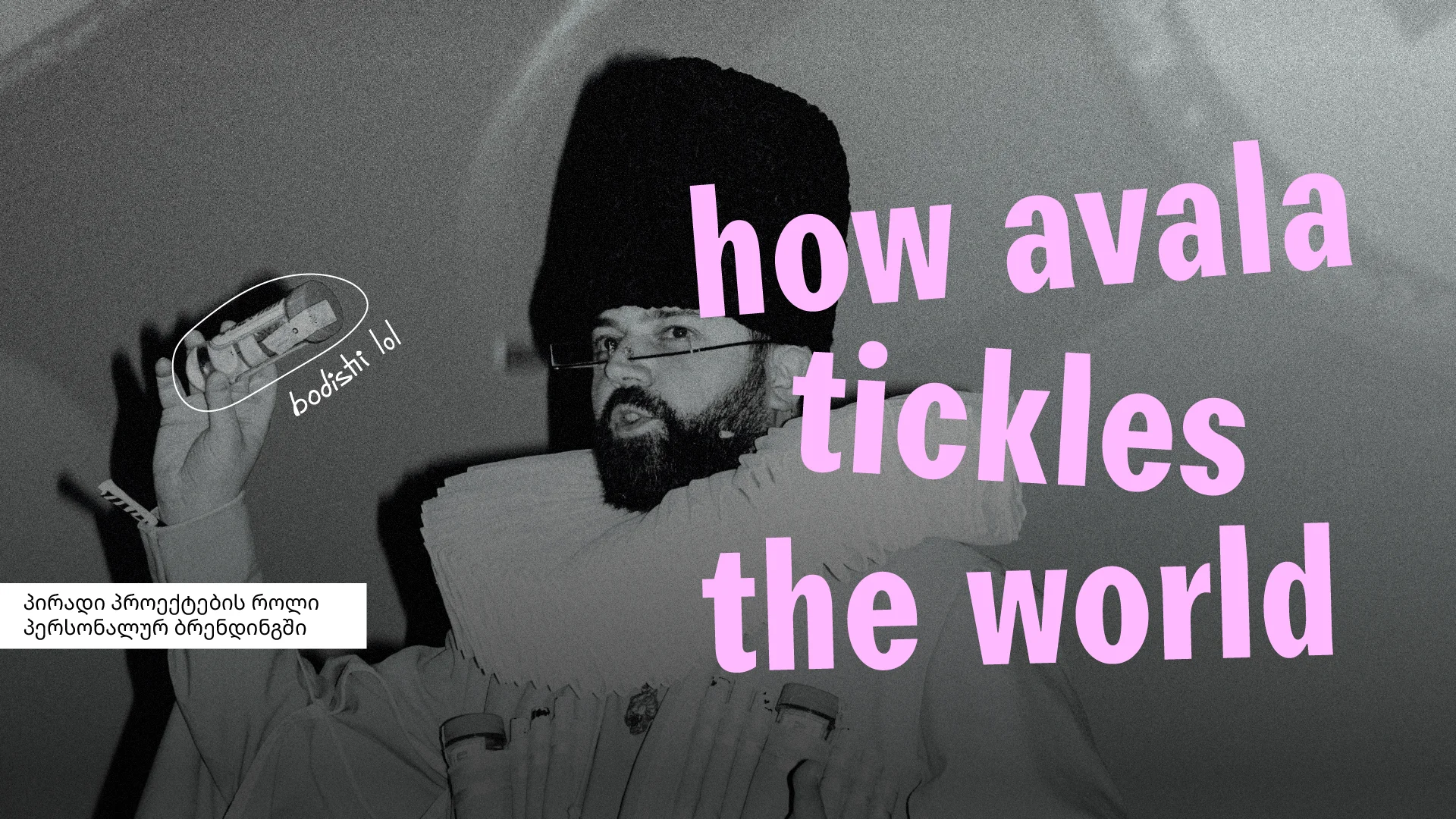
how avala tickles the world
the role of personal projects in personal branding
Imagine you’re in a meeting, sitting across from an agency as the client. The meeting has already started, but the agency team is nowhere to be seen. A few minutes later, the door opens. In walks a cheerful person wearing a pink chokha and the coolest sneakers you’ve ever seen. As an apology for being late, he hands you a tiny bottle of chacha that literally says sorry on it-designed so beautifully that it stands out from every other bottle on the shelf.
This is Avala - Giorgi Avaliani, Creative Director and co-founder of Holy Motors.
“What is the thing you want to do so badly that you simply can’t not do it?”
At first glance, the question may sound too broad. But place it in the context of personal branding and it becomes surprisingly revealing. What is it that speaks most deeply to your identity? What do you feel compelled to contribute to? That, in itself, can become one of the most authentic and powerful expressions of a personal brand.
Social media and AI have made building a personal brand easier - and, paradoxically, much harder. The real challenge is authenticity, and with it, the ability to build genuine connections with people.
While working on another article, we posted on LinkedIn looking for people with strong personal brands. Within a short time, several relevant and interesting profiles reached out to us - people with polished backgrounds, carefully built profiles and sophisticated websites. As it turned out, most of them weren’t even real people.
In this growing clutter, it has become increasingly difficult to express who you are through communication topics, insights, opinions or points of view alone. Something more is needed.
This article is about that “something more” - the thing that introduced Avala to Georgia and beyond, and helped him carve out one of the most distinctive and memorable places in the creative industry.
identity beyond patterns
“I want to tickle the world.”
Suddenly, all those seemingly random things you’ve heard or seen from Avala start to make perfect sense.
Creating a personal brand was never really the intention. And yet: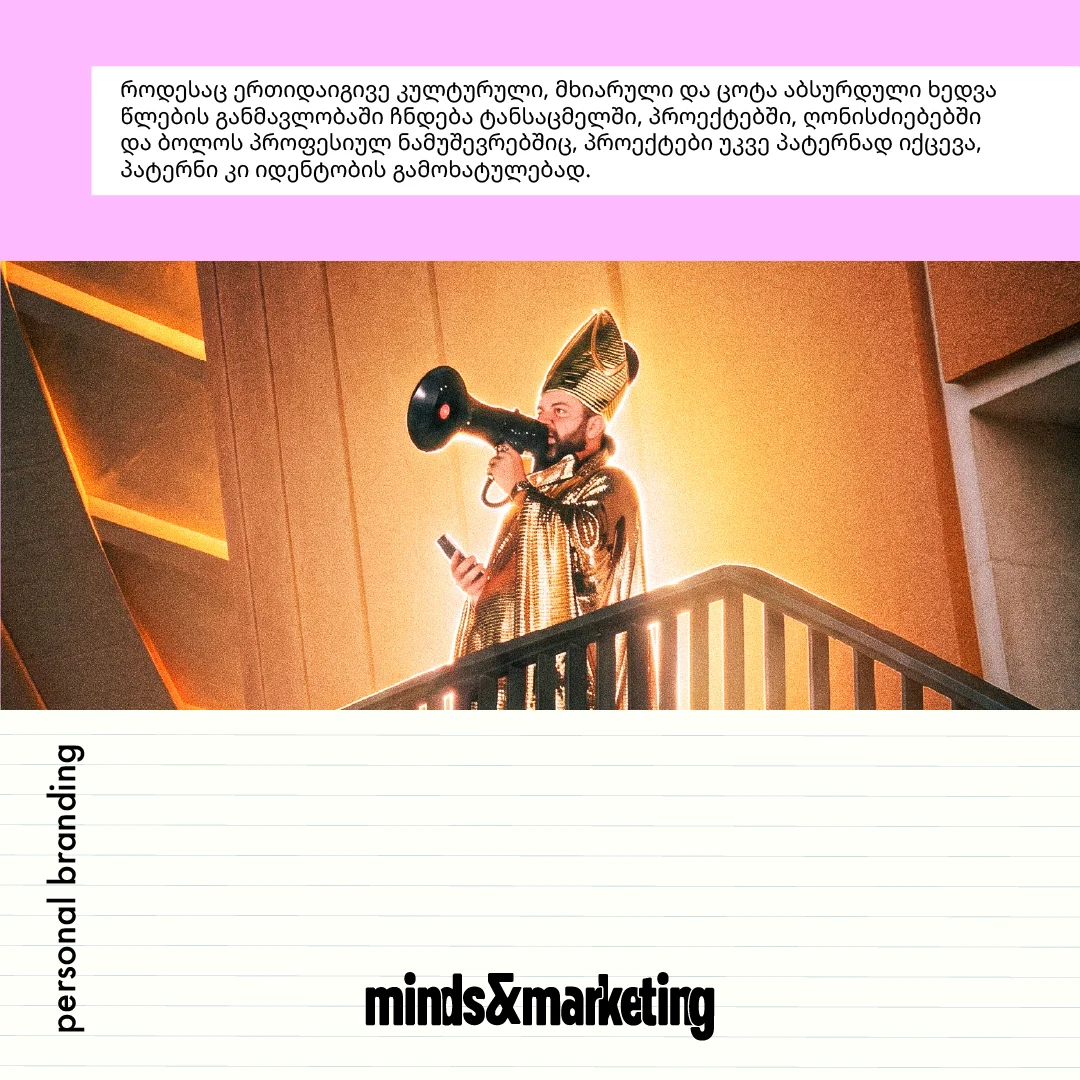
- His everyday clothes and accessories: a Deserters’ Bazaar shopping bag, a tailcoat made from the uniform fabric of a Tbilisi street cleaner, striking rings, an almost unreasonable number of pairs of glasses - and, occasionally, a traditional club.
- The bottle of chacha called “Sorry” he gives clients when he arrives late to a meeting - still, unfortunately, unavailable at pharmacies.
- Emails that, no matter how serious the subject, are impossible to read without at least one smile. The greeting might be unnecessarily grandiose; the sign-off, completely extravagant.
- Special-edition costumes for speaking engagements or hosting: a pink chokha, an enormous khinkali, an inflatable camera - except these aren’t accessories. They are the costume.
Giorgi Avaliani, Creative Director and co-founder of Holy Motors.
“At some point, I realized that all the people whose work I liked and who inspired me were trying to be themselves. Then I looked inside myself and saw khinkali and chacha.”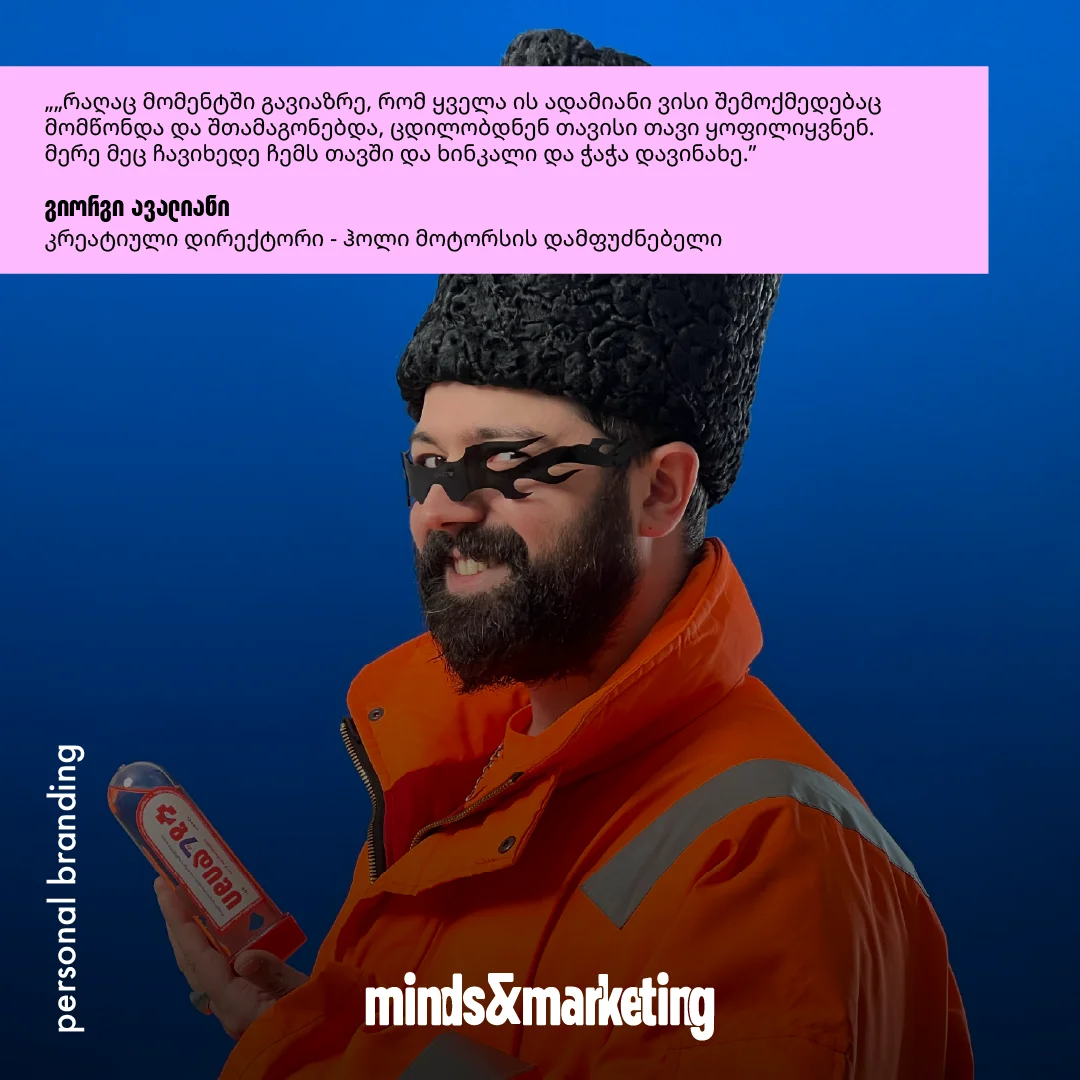
Seeing something is one thing. What matters is what you do with it next - and how you turn it into the axis of your personal brand.
culture - the most alive and continuous source of inspiration
In Avala’s case, it is easy to see how deeply culture shapes his identity and, consequently, his personal brand. The main reason is probably his work itself.
For a creative person, culture is one of the richest sources of inspiration: look around you, notice what isn’t working, take it, transform it, make it better - or simply add your own perspective to it.
“When you take little elements and make them your own, you enjoy them more.”
That is how khinkali got a birthday party. How the pink chokha travelled across stages of the global creative industry. How Avala’s birthday party in Shumbaland came with a spears-only dress code. How a chokha-wearing Batman appeared. And how countless other things became opportunities to, quite literally, tickle the world.
There are often two recognizable tendencies in personal branding. Some people become so focused on their uniqueness that it becomes difficult to connect them to any real-world context. Others become so immersed in their context that their individuality disappears.
Avala’s story is interesting precisely because he manages to do neither.
He took something that already belonged to everyone - culture - and cooked it in his own sauce.
He tickled it.
the insight
The key to the axis of a personal brand is often hidden in the things that won’t leave you alone.
Look around. Pay attention to what bothers you, what makes you itch to change something, what you keep thinking could be different. Then get up and do something about it.
Keep doing that until, eventually, those things start telling you who you are - and what you want to create next.
“The path to building a personal brand as a creative is personal projects. That’s exactly what we tell and teach our students: do personal projects. Invest your resources and ideas into the things you genuinely want to make. Personal projects are a way of discovering your own identity.”
the paradox of personal branding - do you build it so you no longer need it?
Every personal brand has its own lifecycle. Just as with corporate brands, people have different goals and priorities at different stages of their professional lives. Recently, Avala’s personal projects and activity on social media have noticeably decreased - largely because of the creation of his agency, Holy Motors.
Personal projects require time and resources. But there is another side to it.
“Now the work I do is much closer to the work I actually want to be doing, so I don’t make as many things exclusively for myself. At Holy Motors, every project is a personal project for us. And now I can put my full resources into these projects with much more joy.”
Perhaps this sentence captures one of the most important purposes of personal branding: bringing your identity into harmony with what you actually do every day.
And this is where the paradox begins.
You build a personal brand so that, at some point, you no longer need one. Your identity and your perspective become embedded in your creative work, your professional practice and, eventually, the company you build. Which raises another interesting question: what happens next? What happens when the founder’s personal brand and story begin to shape the company’s brand?
“At the agency, we don’t even get briefs that aren’t for us. Anyone who walks through our door already has an expectation of the kind of story they might see unfold for their brand.”
At first, this might sound like a limitation - doesn’t defining your creative identity so clearly risk narrowing your client base?
But relevance to culture is becoming an increasingly important challenge for brands. As that need grows, so does the value of having a creative team capable of connecting a brand to its everyday cultural context in an authentic way. And when that connection becomes part of what an agency is known for, the client base can grow around it, year after year.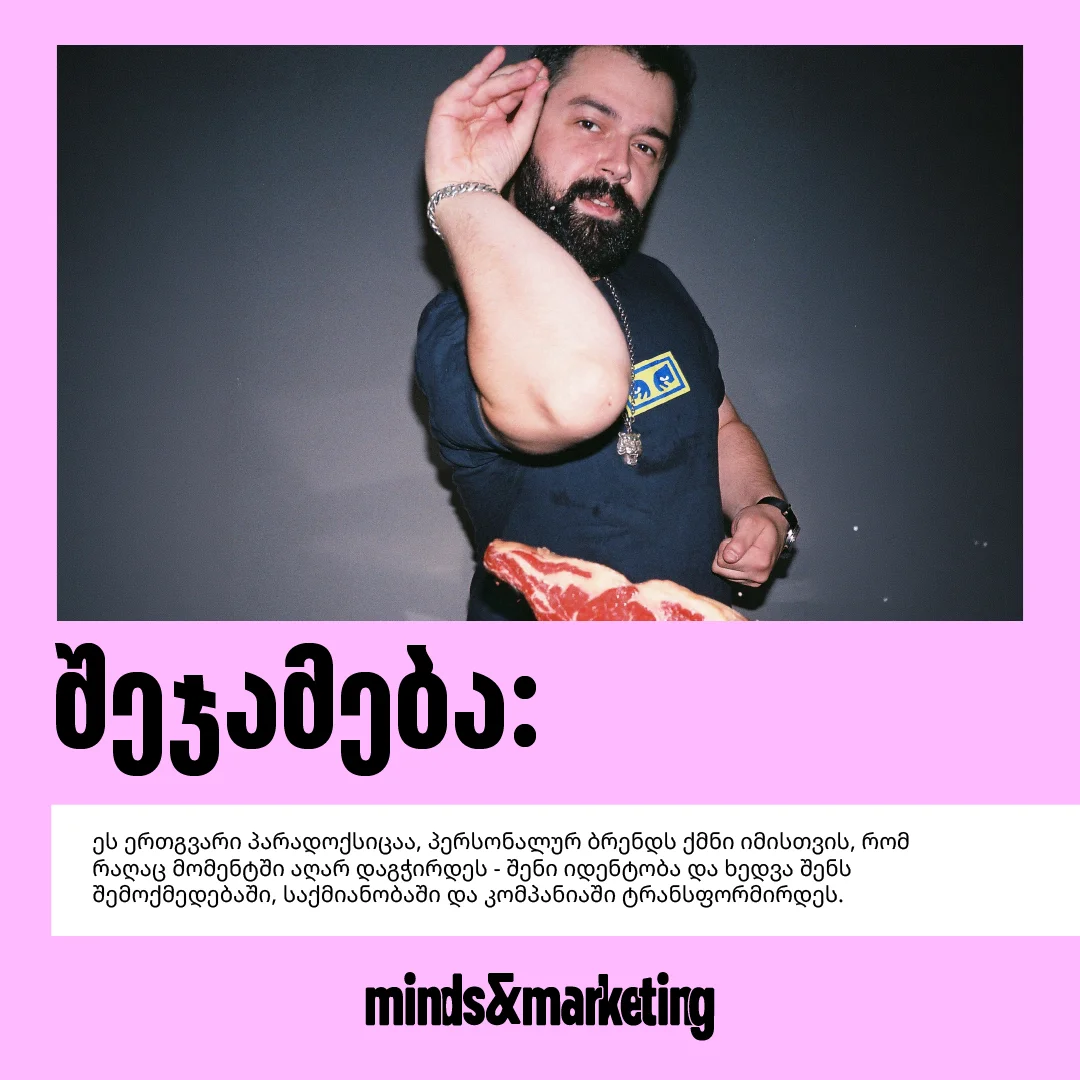
Avala’s personal brand was never designed as a personal brand.
He was simply doing the things that wouldn’t leave him alone. Playing with culture. Looking at the world from his own angle and, quite literally, tickling it.
Over time, khinkali, chacha, the chokha, humour, his way of dressing and his personal projects became recurring patterns. Those patterns became recognizable signals. And eventually, they became an identity people remembered. That is where the real role of personal projects becomes visible. They don’t just show other people who you are. They help you discover it yourself.
In Avala’s case, the process eventually went one step further: the boundary between personal and professional creativity began to disappear. Today, the perspective that once required personal projects to express itself lives in his everyday work - and in the brand of Holy Motors itself.
Perhaps that is one of the most interesting paradoxes of a strong personal brand:
You create, experiment and express yourself until, one day, you no longer need a personal brand at all.