
founder’s personal brand
business growth accelerator or a glass ceiling?
You’ve probably heard the phrase: “My business is my child.” For founders, it reflects ownership, responsibility, and devotion. But what happens when the business is not just your child — but entirely you?
At different stages of growth, founders play very different roles inside a business. Through both Georgian and international examples, this article explores when a founder’s personal brand becomes an advantage — and when it turns into a barrier. More specifically, how a founder’s visible, consistent, and public persona impacts the growth of their own business.
celebrity and creator-led businesses
This is the clearest case where the founder is the brand. Their identity, values, community, visual language, and lifestyle almost fully translate into the product or service itself.
While the Georgian market already has many examples — Dopamine by Kako, Beauty and the Box by Teona Tavartkiladze, Hungryman chips, and others — Goop and Gwyneth Paltrow remain one of the most illustrative large-scale cases.

Every Goop product, initiative, and experience is built around the founder’s lifestyle and interests. When you buy Goop clothing, skincare, or home decor, it feels less like purchasing a product and more like buying into Gwyneth’s way of living. And for consumers who truly value that lifestyle, they are often willing to:
- overlook product flaws;
- purchase experimental products without excessive expectations or hesitation;
- buy directly from Gwyneth’s Instagram Story without the need for large-scale marketing campaigns.
Behind these almost priceless effects stands the founder’s active and public personal brand — functioning simultaneously as a source of trust, awareness, distribution, media power, brand ambassadorship, and ultimately, business growth.
But the interesting question is: at what point does Gwyneth hit the glass ceiling?
When does a creator’s or celebrity’s personal brand become a limitation for business growth?
- when the business becomes inseparable from the founder’s identity, limiting the organization’s autonomy and independent evolution;
- when the founder’s personal brand becomes involved in controversy or scandal;
- when the “hype” surrounding the personal brand fades, leaving consumers with just another product;
- when followers develop rigid expectations toward the founder, creating what sometimes feels like an invisible imprisonment of their public persona.
Among these, the second and fourth risks are somewhat manageable and preventable. The first and third, however, are structural realities that founders can only partially influence.
At the same time, the upside of activating a strong personal brand is often significantly greater. But for that personal brand to truly function as a business accelerator:
- the founder’s identity must be clear and consistent;
- products and experiences must feel like natural, harmonious expressions of that identity and its human values;
- the community should feel included in the growth journey — the stronger the sense of “knowing” the founder and participating in their story, the more valuable the connection becomes for the business;
- the founder’s personal brand should evolve into an inseparable part of storytelling and the foundation of the brand’s media ecosystem.
how does a founder’s personal brand startup stage
While celebrities and content creators usually build products around their identities, startup founders often do the opposite: they adapt their founder story to strengthen the business.
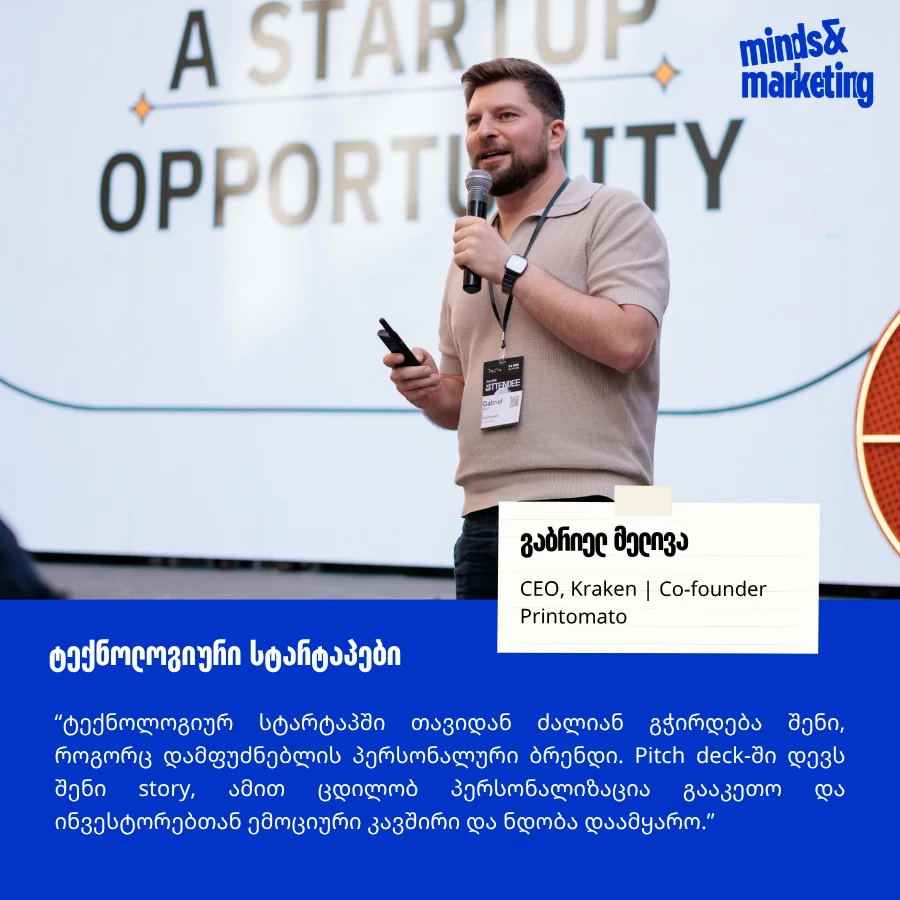
Gabriel Meliva, Co-founder, Printomato | CEO, Kraken:
“Especially in tech startups, at the beginning you really need your personal brand as a founder. Your story is inside the pitch deck. You use it to personalize the business and build emotional connection and trust with investors.”
The deeper and more personal the connection between the founder’s story and the problem the startup is solving, the stronger the signal it sends — both to investors and consumers — that the team genuinely understands the audience and is fully committed to solving the problem.
At this stage, a founder’s self-reflection, authentic storytelling, and communication of personal values directly shape the first layer of trust around the business.
“The first fundraising round is always invested into the founder. Then you enter the market and consumers still ask for personalization, your story, again and again, to build trust. But at some point, that has to stop.” — Gabriel Meliva
A strong Georgian example is Caru and its founder, who still actively appears across the brand’s content ecosystem. The interesting question is when that strategy will eventually shift — because alongside the benefits, the risks also begin to emerge on the horizon.
For example, many people likely remember the recent Gardenia Shevardnadze crisis, where the founder became the central figure of the controversy.
Less productive sides of activating a founder’s personal brand within traditional business models:
- strong storytelling and personal charisma can temporarily overshadow flaws in product-market fit;
- as the startup begins scaling, investors and partners naturally start asking whether the business is systemically strong enough to remain stable without the founder;
- the founder’s behavior, opinions, and public positions directly shape perceptions of the business itself.
But what happens when the founder’s personal brand continues to remain highly public even after the company matures?
founder-led corporations
Pros: According to Harvard Business Review, research conducted across S&P 500 companies found that organizations where founders remain actively involved — and maintain strong public personal brands — create 31% more patents, tend to be more innovative, and operate with a longer-term vision.
Cons: On June 5, 2025, amid Elon Musk’s public conflict with Donald Trump, Tesla’s stock price dropped by 14%, reducing the company’s overall value by approximately $140–150 billion.
And it would be impossible to finish this article without mentioning Temur Tchqonia as one of the strongest Georgian examples of a founder’s personal brand positively influencing business. For decades, he has managed global brands such as Coca-Cola and McDonald’s in Georgia. Despite increasing competition and changing public attitudes toward healthy eating, McDonald’s continues expanding nationwide, while the Coca-Cola factory has become such a benchmark for operational systemization that representatives from different countries regularly visit it.
But perhaps the most interesting part of this story is the tandem between these brands and Tchqonia’s personal brand itself. Despite the enormous scale of Coca-Cola and McDonald’s, Temur Tchqonia has managed to preserve a highly distinctive and independent personal identity, clearly rooted in entrepreneurial spirit.
At the same time, from an outside perspective, both companies still appear as fully independent, systematically structured organizations — businesses that carry the founder’s values, yet clearly possess the operational capacity to function without him.
key finding
In the early stages of business growth, the founder’s public persona often becomes the primary source of trust, emotional connection, investment, and early momentum.
But as organizations grow, tying an entire business to the identity of a single person becomes increasingly complex and risky.
If personal branding functions as an accelerator in the beginning, later it can evolve into either a competitive advantage or a systemic risk — especially when the company’s reputation, financial stability, and consumer trust become directly dependent on the founder’s lifestyle, values, and behavior.
conclusion
A founder’s personal brand is neither automatically a guarantee of growth nor an inherent threat to a business.
Its impact depends entirely on two factors: