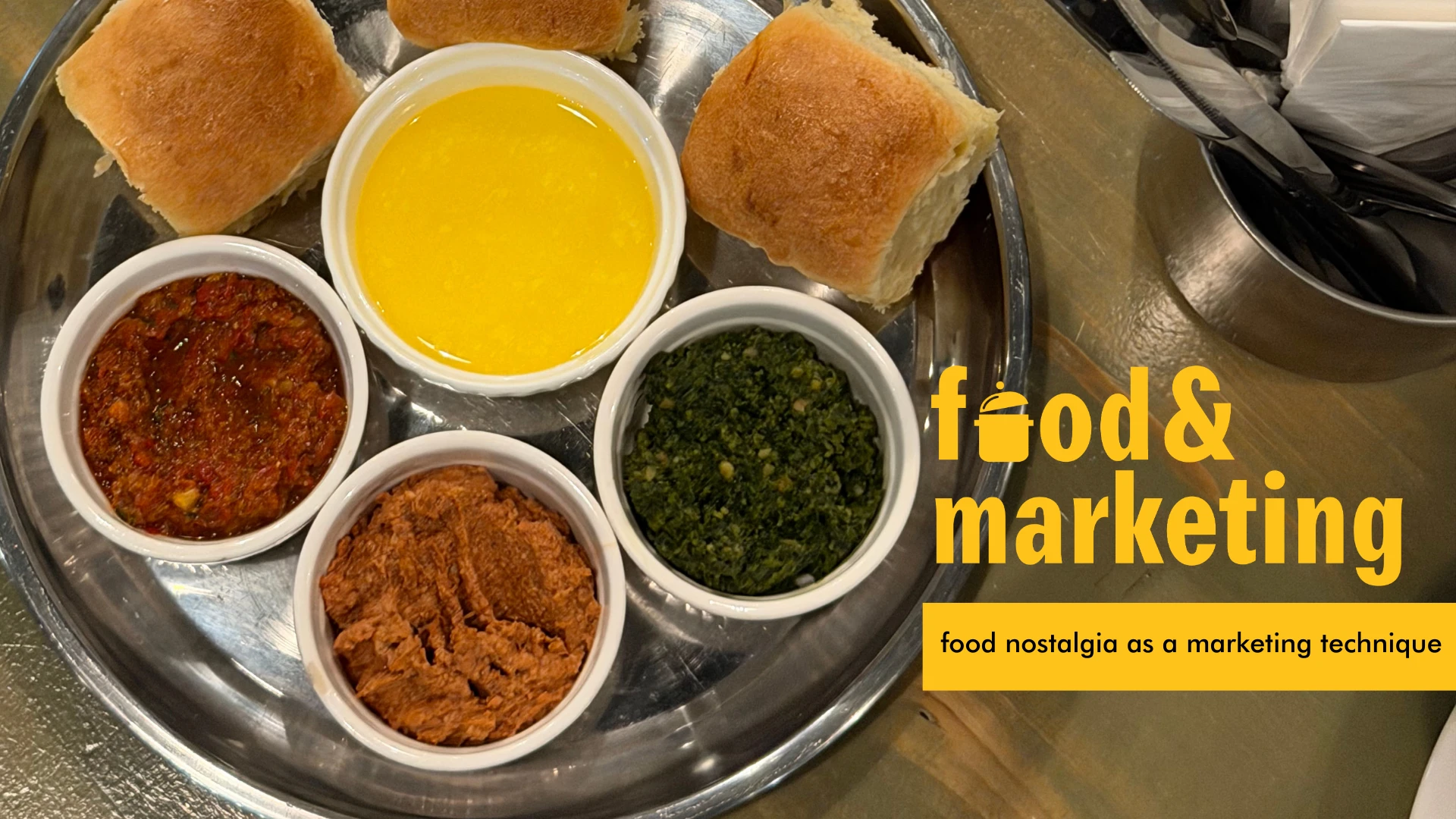
food nostalgia as a marketing technique
Rebranding Dishes
Close your eyes for two seconds and answer honestly: Which flavor instantly takes you back to childhood?
It could be fried potatoes with tkemali, a scoop of plombir ice cream, crunchy cucumbers from your backyard, or your grandmother’s pan-baked khachapuri.
Whatever came to mind, rest assured: your answer can absolutely be used by restaurateurs—not against you, of course, but very effectively to attract you.
Today, we’re talking about nostalgic flavors and their emotional power—how nostalgia turns into a marketing instrument and where Georgian gastronomy stands in this process. Together with Georgian brand-chefs Tamta Kikaleishvili and Luka Nachkebia, we explored this topic and are sharing the key insights.
nostalgic flavor & comfort food
Nostalgia is a sentimental longing for the past, usually tied to positive emotions. Many factors can trigger nostalgia, including sensory stimuli—especially taste and smell. That’s exactly why we started by asking about childhood flavors. And if you’re wondering how your brain can recall a smell or taste so instantly, here’s what’s happening behind the scenes.
The emotional connection between taste and memory is deeply embedded in the brain and represents a complex neurological phenomenon. Taste and smell are processed close to the hippocampus — the brain region responsible for forming and storing memories. This proximity explains why certain smells or flavors can provoke intense emotional reactions and mentally transport us to a specific time and place.
This is also the foundation of the comfort food phenomenon. Comfort food refers to dishes that carry nostalgic and sentimental value, creating a sense of safety and emotional ease. It can be any food that holds personal nostalgic meaning, most often linked to childhood memories.
Research shows that nostalgia can significantly influence consumer behavior—encouraging purchases, strengthening brand loyalty²˒³, and more. For brands, gastronomic nostalgia is therefore a powerful marketing tool, enabling direct access to consumers’ memories and emotions.
According to Luka Nachkebia, nostalgic flavors are rooted in biochemical processes that begin once an old emotional imprint is triggered:

“When something in life is emotionally encoded and associated with a strong sensation, nostalgia is essentially the activation of those emotions through some mechanism. That mechanism can be smell, taste, sound, music, a physical sensation, even a breeze—anything.”
the role of nostalgia in contemporary georgian gastronomy
Today, elements of nostalgic food and comfort food can be found in many restaurants and cafés across Georgia. But Georgian gastronomy didn’t arrive here overnight—it went through a long journey and multiple transformations.
Tamta Kikaleishvili recalls that when she started her career 15 years ago, one of the dominant trends was molecular gastronomy:
“Years ago, both in Georgia and globally, there was a boom in molecular cuisine. We were imitating trends we only understood visually, without technical knowledge or experience. We didn’t have trainers, so we learned mostly through our own mistakes. People loved the foams, droplets, and visual effects, and many tried to recreate that aesthetic.”

Eventually, the molecular gastronomy wave faded, and nostalgic dishes moved to the forefront. Chefs—and people in general—started digging into their childhoods, researching and recalling old flavors and emotions.
“It was like returning to your ex,” Tamta says, “back to basic flavors.”
She outlines three main reasons for this shift:
-
Georgians love Georgian food.
-
With proper research and product knowledge, local ingredients allow you to create a higher-quality menu at a more accessible price point than imported products. Imported ingredients raise costs and often compromise quality due to long transportation and storage conditions.
-
Tourists visiting Georgia want to taste Georgian food and experience Georgian culinary culture.
For Georgians, many traditional dishes already function as comfort food. Simply including classic Georgian dishes on a menu automatically introduces a nostalgia component.
According to food technologist and chef Luka Nachkebia, nostalgia is a key factor when designing a menu—at least half of it should be nostalgia-based. From a commercial standpoint, he believes a successful menu must rely on two pillars: nostalgia and evolutionary psychology.
“Evolutionary psychology points to universal truths in how we perceive taste—truths that stimulate the amygdala⁴. Once dopamine is exhausted, you activate dopamine and serotonin through memories and by revisiting flavors people might have experienced in childhood. You then search for flavors shared by the largest number of people and base at least half the menu on them. The other half should be something new.
Nostalgia has a big advantage: when people try something new alongside a nostalgic dish, the positive emotional effect transfers. When creating a menu, we try to ensure that out of six main dishes, at least three or four are nostalgia-based, and then we ‘sneak in’ the rest.”
gastronomic ostalgia as a marketing tactic
Retro packaging, classic flavors, vintage advertising—these and many other nostalgia triggers evoke positive emotions, memories, and a sense of familiarity and comfort.
Over time, numerous food & beverage brands have used nostalgia as a marketing tool. One of the most iconic examples is Coca-Cola, especially known for its Christmas campaigns built on classic holiday visuals that evoke warmth, togetherness, and coziness.
We asked our respondents what role nostalgia plays—marketing-wise—in the success or failure of a menu and a restaurant overall.
According to Luka Nachkebia, experience makes it easier to identify flavors that form the basis of nostalgia: fried potatoes, the smell of onion or garlic, simple sweets, tomato juice, khinkali broth…
The next step is reinterpreting these aromas in different forms across the menu:
“At Tsekhi, we have an anti-menu, which I wouldn’t recommend for commercial menus. We balance it with other components—music, atmosphere, interior details. If I had a purely comfort menu, I wouldn’t stand out; I’d be competing directly on price and quality.

I prefer competing on nostalgia—using supporting elements—and at the same time introducing flavors that only I offer. Many of them are intentionally simple and comforting, so they don’t intimidate the guest.
Our principle is this: we modify details of traditional dishes to create something new, but there must always be a connection to the original. I try to train the customer to come to the restaurant not for a specific dish, but for the people behind it. When people come for a brand as an identity—not just food—the restaurant lasts longer.”
Tamta Kikaleishvili emphasizes that everything starts with the restaurant concept, and only then comes the balance between the menu and the chef’s creative vision:
“FARM’s menu was designed around Georgian comfort food. We were bolder there—using more fat, spice, and acidity, which are characteristic of Georgian cuisine.
With Brod, which is based on Scandinavian notes, we created a crossover between two gastronomies. Here too, I introduced nostalgic flavors. For example, we have a ‘Chinese cake’ on the menu—something almost everyone loves. We also made a roulade. I always remember that there was chocolate roulade at home, or someone would bring it over. In markets, roulade and wafers were among the first ready-made desserts.
Of course, we refined it—using high-quality chocolate and ingredients—but visually, it takes you back to evening tea time and pulls you into the past.”
As our conversations with Tamta and Luka confirmed, nostalgic dishes being a strong current trend is no coincidence. Chefs pay close attention to this element. But what’s next? Will nostalgic dishes remain on menus, be replaced by new forms of nostalgia, or fade altogether?
The Future of Nostalgic Flavors
Luka Nachkebia believes we’re at a crossroads:
“Fusion is largely exhausted. Now the era of ‘New Georgian’ cuisine is coming. I tell my colleagues—and try myself—we know our foundations, what is fundamentally Georgian. Now we need to create new dishes. Principally new ones.
Take chakondrili—it didn’t exist until recently, yet now it feels like it’s always been there. We need to create entirely new things, knowing that every new dish will become ‘standard’ in three or four years.
We must think about why we like certain nostalgic dishes. What creates nostalgia? Which aroma, which sensation? In 10–15 years, even I won’t know what will be nostalgic for the next generation or what they’ll have emotional bonds with.
Either we involve others to understand this—or we consciously create those emotional bonds ourselves.”
So, the rise of nostalgic flavors isn’t accidental. As more people travel abroad and experience other cuisines, they increasingly seek authentic, homeland flavors when living in Georgia. Tourists, meanwhile, often explore the country first and foremost through its gastronomy.
In this context, nostalgic flavor is not only a marketing tool—it’s also a means of preserving and developing Georgian cuisine and gastro-tourism. How exactly this happens, through which strategies and flavors, we’ll explore step by step in the future.
Until then, tell us: Where do you look for—and where do you find—the flavors of your childhood?