
building a bond with fans
the marketing challenges of georgian football clubs
In Georgian club football, marketing often remains in the shadows - while globally, the sport’s commercial and emotional value is largely driven by it. In Europe, football has long outgrown the pitch: it has become culture, business, and brand - where the fan is much more than a consumer.
In Georgia, however, club marketing is still in its early stages: emotions are strong, but structure and strategy are weak. The average attendance in the national league hovers around 2,000 spectators per match - one of the lowest figures in Europe.
Clubs are trying to respond to this challenge in different ways - each with its own resources, but with a shared goal: bringing fans back to the game and the club. We often say football is in our DNA, yet we fail to translate that passion into action. Empty stadiums, declining quality of play, absence of fan culture, and ongoing financial struggles - the list of challenges is long.
minds&marketing set out to explore how Georgian football clubs use marketing and social media to communicate with fans and build their brand narratives. We focused on the key challenges in club marketing today and the opportunities that could shape the future. To gain firsthand insights, we spoke with Nugo Otinashvili, Marketing Manager at Dinamo Tbilisi, and Davit Kipiani, Technical Director at Lokomotive Tbilisi.
The Role of Marketing in Club Perception: Where Do We Stand?
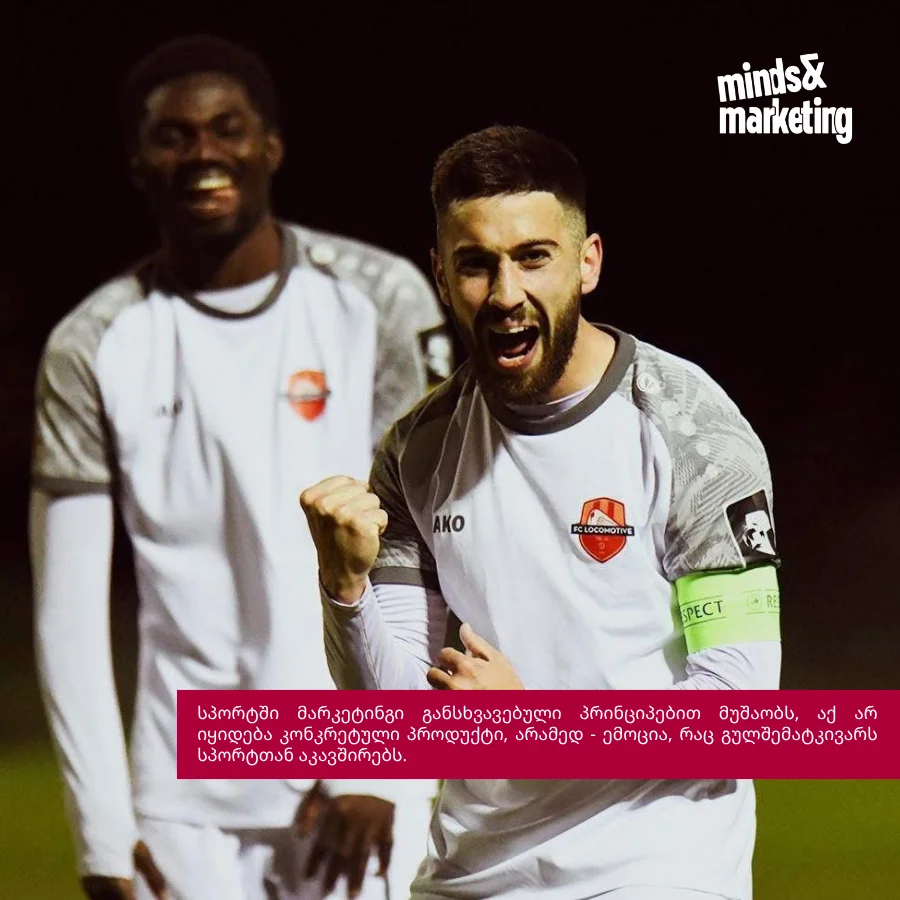
In sports, marketing operates by different principles - you’re not selling a product, you’re selling emotion, the connection that ties fans to the sport.
In Georgia, however, marketing is often perceived as an additional cost, not a strategic necessity. This perception directly impacts results. In reality, marketing is one of the club’s essential components for brand-building and for attracting and retaining fans - arguably its most important stakeholders.
Davit Kipiani, Technical Director, Lokomotive Tbilisi:
“Some steps are being taken, but they’re not enough. Marketing in clubs is often limited to social media, while it should extend far beyond that. The main challenges are limited financial resources and the lack of qualified personnel. We need a fully functioning marketing department. We have ideas for brand strategy development, but at this stage, we simply don’t have the resources.”
A similar challenge is echoed by Dinamo Tbilisi. Both clubs have strategic ideas, but lack the financial means to implement them.
Nugo Otinashvili, Marketing Manager, Dinamo Tbilisi:
“Our main focus now is on partnerships and sponsorships, but we do have a broader strategy we haven’t been able to fully execute - mostly due to financial constraints. There are different types of fans - those driven by sporting results, and those who attend every game out of pure love for the club. Our goal is to engage both.”
Stadiums Without Fans
Let’s move to perhaps the most painful topic - empty stadiums.
Attendance, commercial revenues, and digital engagement of Georgian clubs lag far behind European averages, even compared to second-division leagues.
Dinamo Tbilisi attracts an average of 1,000–2,000 spectators per match, filling less than 4% of its 54,000-seat arena. In 2023, average attendance dropped below 800.
Nugo Otinashvili, Marketing Manager, Dinamo Tbilisi:
“Improvement depends not only on the club but also on the fans themselves. Physical engagement is key, and that requires continuous effort from the club.”
Lokomotive Tbilisi, even during top-division seasons, draws fewer than 600 fans per match - a clear reflection of the scale of the problem.
Davit Kipiani, Technical Director, Lokomotive Tbilisi:
“Football is entertainment - that’s why people come to the stadium. But even when we reached the Europa League and achieved unprecedented results, fan turnout didn’t increase.
A football match must be turned into an event, an experience - not just a sporting occasion. In Georgia, there is practically no fan culture, which is also linked to the declining quality of the game.”
Indeed, matchday marketing is almost nonexistent - no city buzz, no anticipation, often not even awareness of when a match is happening.
Georgian Clubs in the Digital Space
Digitally, Dinamo Tbilisi leads Georgian clubs with around 220K followers on Facebook and 30K on Instagram (as of 2025).
Nugo Otinashvili, Marketing Manager, Dinamo Tbilisi:
“One of our main challenges is that engagement is heavily dependent on team performance. Our current focus is on developing digital platforms. We’re most active on Facebook and Instagram, have a YouTube channel with great potential, and plan to expand on TikTok. Engagement is directly tied to emotional content - our matchday posts perform best.
The main obstacle is building distinct content strategies for each platform and reducing dependency on game results - which is difficult in our context.”
Lokomotive Tbilisi, in contrast, maintains a much smaller digital audience - around 30K on Facebook and 6K on Instagram, indicating significant room for growth.
Lack of creative content, underused YouTube and TikTok platforms, and the absence of a clear digital strategy are among the key barriers preventing clubs from building stronger fan engagement. The result: weak emotional connections between players and fans - and, ultimately, empty stands.
Let’s Talk About Sponsors
The Achilles’ heel of Georgia’s sports ecosystem. Without sponsors and financial backing, marketing naturally comes to a halt. The simple truth: without a budget, nothing moves in Georgian sports.
Businesses are reluctant to invest in sports because they don’t see the value — stadiums are empty, games are rarely broadcast, and digital reach remains limited. Clubs can’t fix this cycle because they lack funding to improve visibility — a closed loop with no clear way out.
According to 2021 data, Dinamo Tbilisi earned ₾365,000 from sponsorships and ₾765,000 from merchandise — less than 10% of total revenue. The majority came from UEFA prizes (~₾3 million) and state subsidies (~₾3 million) (source: bm.ge).
Nugo Otinashvili, Marketing Manager, Dinamo Tbilisi:
“Very few businesses in Georgia invest in sports - mainly those in gambling, banking, and construction. Currently, sponsoring individual athletes is more popular than supporting clubs.”
Lokomotive Tbilisi operates with minimal commercial income, relying on federation and municipal support, and lacks major sponsors.
Davit Kipiani, Technical Director, Lokomotive Tbilisi:
“The absence of televised games directly impacts fan engagement - if people can’t watch matches, they’re less motivated to attend.”
On a positive note, Lokomotive has introduced a governance structure that separates board-level strategic management from day-to-day operations, which can be seen as a progressive step toward long-term club development.
In essence - without money, marketing cannot grow; without marketing, money doesn’t come in.
The Way Forward
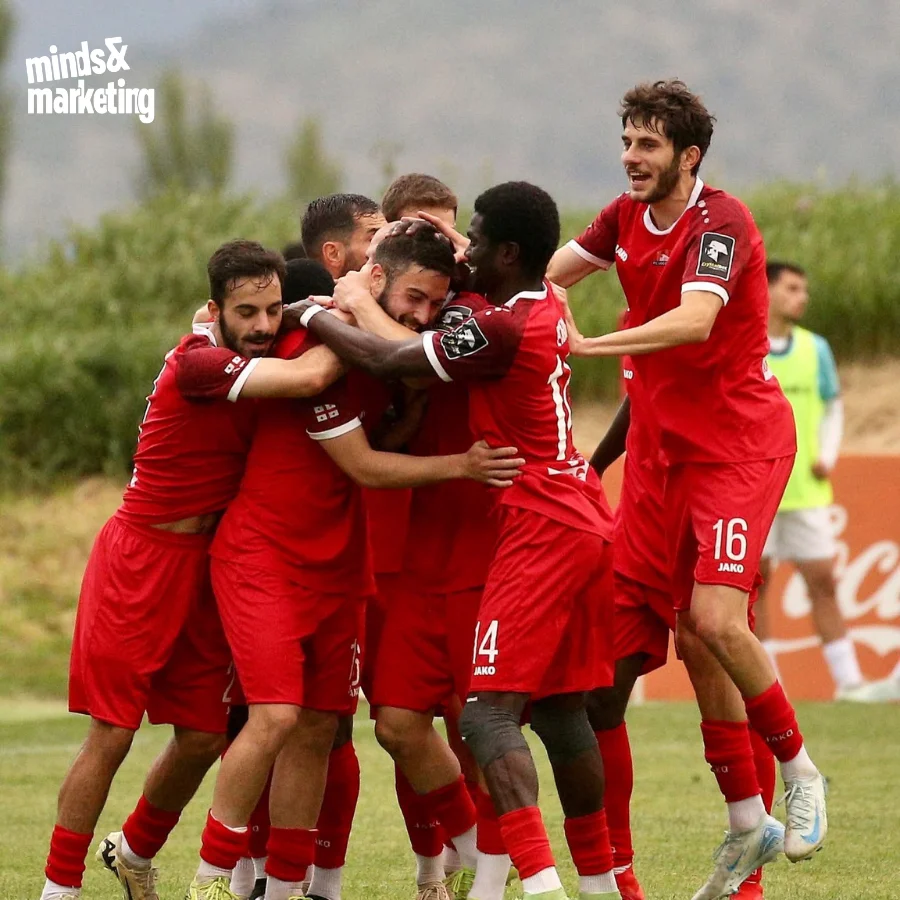
The solution lies in returning to football’s essence - the fan and the emotion. These two elements give meaning to the sport and life to the club. When a club loses its connection to fans, it loses everything that keeps it alive.
The next step for Georgian clubs is not just finding sponsors, but rebuilding relationships with supporters.
Even without large budgets, the digital space offers an opportunity to build a solid foundation through creative, fan-focused, and strategic content. Behind-the-scenes videos, player stories, matchday vlogs, and local fan activities can make the experience more engaging.
Matchday should feel like a celebration - a day when the city wakes up to the sound of football. Fans should want to be there.
Systemic change begins when marketing is no longer seen as an expense, but as an investment in the club’s future. When every link - club, player, business, and fan - works toward a shared goal, Georgian football can finally unlock both its economic and emotional potential.
Georgian club marketing is only beginning to find its identity. The road is long, but possible - as long as there are fans who still wait for the roar of the stadium and the emotions that make this game unlike any other.