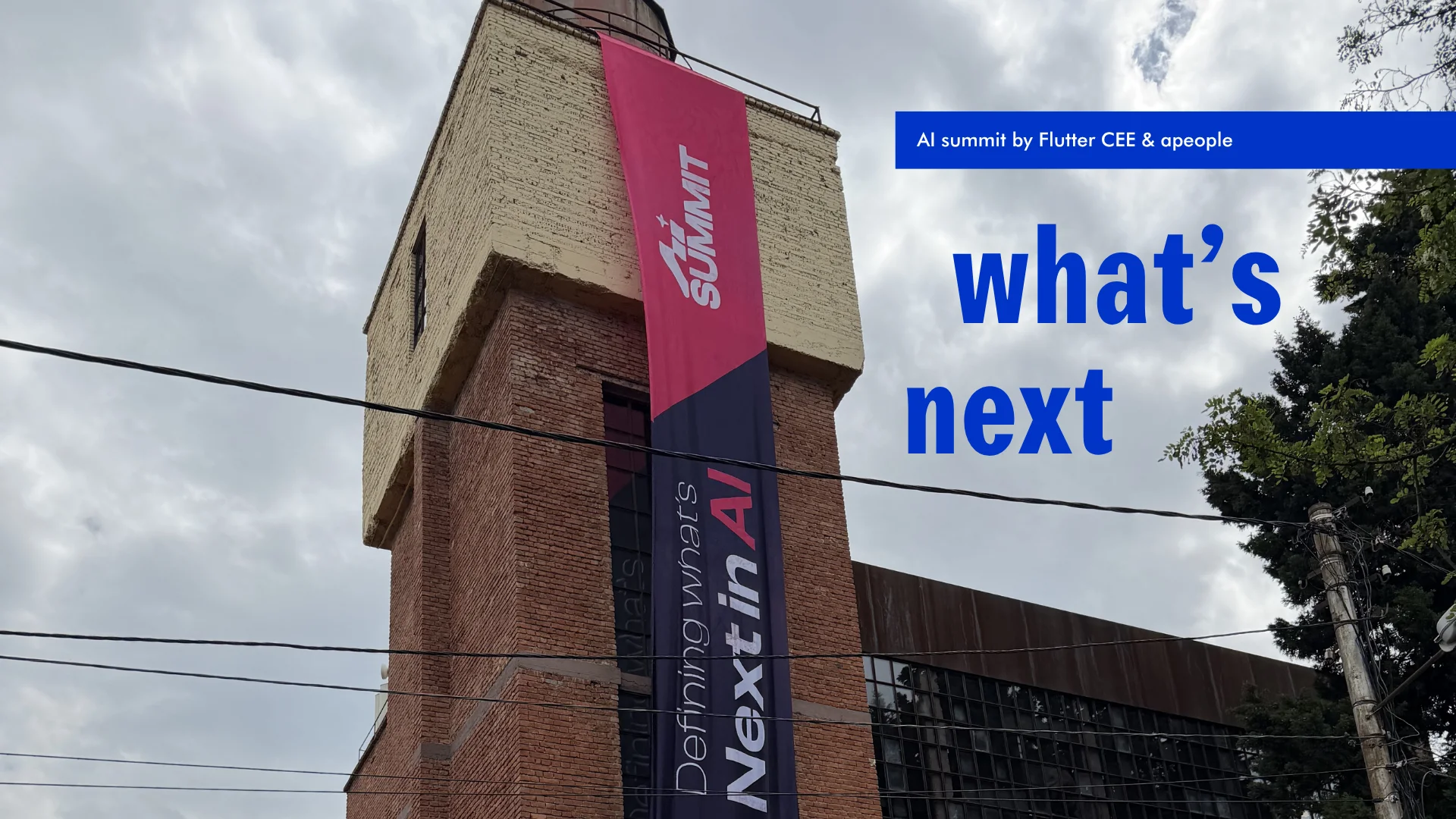
event as a brand positioning tool
AI summit by Flutter Central & Eastern Europe & apeople
written by: mariam bebiashvili
Imagine this: you need to schedule a meeting with five colleagues, but you have no visibility into their calendars or availability. How long would it take to complete what seems like a fairly simple task?
If you work at Flutter CEE or apeople, less than a half minute – because an AI assistant called Cody will do it for you. But more on that later.
Today, we’re taking you inside the AI Summit organized by Flutter Central & Eastern Europe, hosted at apeople’s office and bringing together nearly 300 representatives from the tech ecosystem: engineers, product leaders, founders, and technology companies.
Of course, we’ll talk about artificial intelligence itself and the insights shared by both international and local experts. But we also want to look at the event from another angle – as a strong example of how events can become strategic tools for brand positioning and employee branding.
event as a positioning strategy
Events are one of the most powerful strategic tools for brand positioning because, unlike digital advertising, they create emotional connection. They give people the opportunity to physically experience a brand’s values, culture, and mindset.
As mentioned above, the summit took place at apeople’s office, and the company’s CMO, Zuka Maghalashvili, emphasized exactly this role of events in shaping brand perception:
“People usually describe us as a ‘fun brand’ where ‘good people work,’ and while that’s true, it’s not the core message of the brand. We’ve made significant progress in tech and especially in AI, and we want that to become visible – both for the industry and for future employees.”
And this is where events become especially important from an employer branding perspective. They allow companies to showcase achievements, culture, and innovation directly to potential employees – attracting and engaging talent, particularly in tech, where qualified professionals are one of the industry’s most valuable resources.
At the beginning of the summit, Flutter CEE CEO Irakli Asanishvili said:
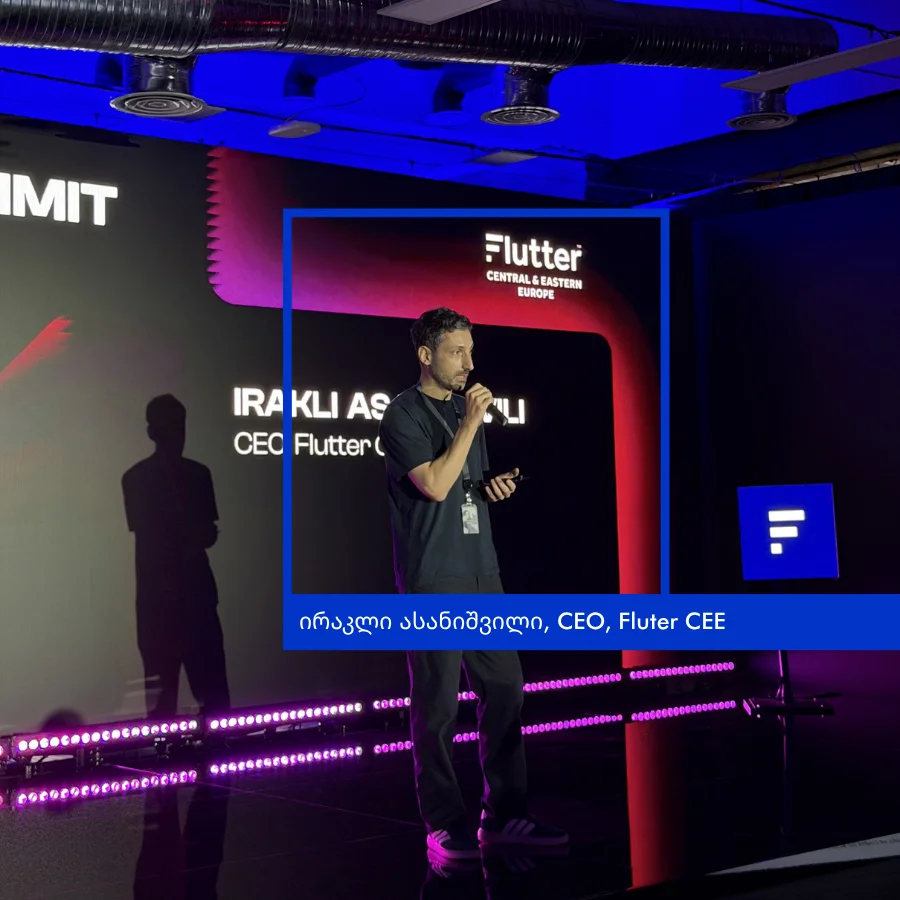
“I still don’t see enough transformation happening in other organizational functions through these technologies – areas like marketing or finance, for example. So my message is this: if you have an idea, product, or service that your current workplace cannot support, we are open to dialogue. Just come talk to us.”
And judging by the number of people gathered around Flutter’s stand, a lot of conversations probably started right there.
Visual identity also plays a critical role in how an event positions a brand. It becomes a kind of visual language – communicating the event’s message, quality, and atmosphere without saying a word. A well-developed visual system shapes audience perception from the very first moment.
Designer Tina Gordeladze (Titishka) explained that the event’s visual direction was entirely driven by its content:
“Our main goal was to show Flutter’s evolution – to create a brand guideline connected to technology, one that reflected dynamism, modernity, and progress. Through merchandising, we also wanted the AI Summit to come alive physically for the guests.”
The summit itself was designed as a multi-layered experience. There was a main stage, a startup zone where Georgian startups showcased innovative services, Flutter’s stand sharing career opportunities, and even a UFC-inspired space in the courtyard where posters were printed live.
In short: multiple touchpoints for networking, entertainment, and learning.
Gift bags, badges, different thematic spaces, speakers, a comfortable environment, the afterparty – every detail shapes how guests experience a brand. And in this case, the impression was strong.
What stood out most was that every single layer of the experience reflected intention, strategy, and quality.
content and speakers — defining what’s next in ai
No matter how polished the visual side of an event may be – the colors, gifts, activations, or staging – content remains the most important layer.
At events like this, speakers and expertise define credibility.
The AI Summit featured speakers and panelists not only from Flutter International, but also from Amazon Web Services, IBM, and other global technology companies.
According to Flutter CEE CIO Anri Jikia, the summit’s goal was not simply to talk about AI, but to create a space for real exchange:
“When planning the summit, our main idea was not just to discuss artificial intelligence, but to create a space where people could share practical experience and concrete examples – how AI has already been integrated into our daily operations and workflows.”
The conversations extended far beyond technical implementation. Speakers explored how AI is already reshaping – and will continue reshaping – human thinking, business decisions, data processing, and corporate culture.
A few insights that stood out to us:
- Advice for individuals: artificial intelligence will not replace you – but someone using AI absolutely might. Start experimenting and learning today.
- Advice for managers: teams need time to adapt to AI, and they need room to make mistakes. Early-stage mistakes are inevitable, but they are also part of the learning process.
- Advice for businesses: stop asking “Where can we use AI?” Instead, look at the tasks your teams still do manually and identify where AI can accelerate or improve workflows.
This exact question was asked inside Flutter as well – and one of the answers became Cody, the company’s internal AI assistant.
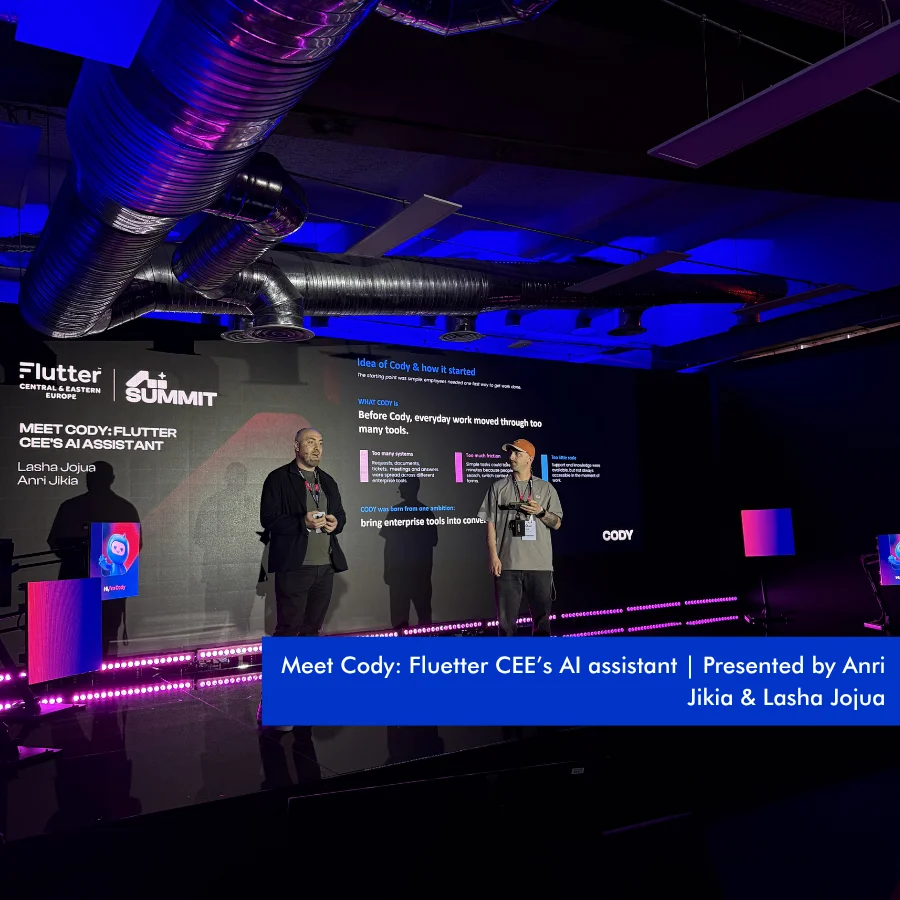
cody — the ai assistant
We started this article with a scheduling example, but Cody can do much more than that.
As Lasha Jojua explained, Flutter assembled a dedicated team focused on integrating AI technologies internally, and Cody became one of its first products:
“We started actively working on Cody four months ago, and today it officially launched. Before starting development, we asked employees where they saw the biggest advantages of AI. That helped us identify priorities. We realized employees had to work across too many windows and systems every day, while Cody brings everything into one interface, simplifying daily tasks and accelerating processes.”
In many ways, Cody reflects one of the most important shifts happening around AI today: the real value often isn’t in creating entirely new behaviors, but in removing friction from existing ones.
final thoughts
The final speaker of the event was Rahaf Harfoush – a digital anthropologist and author researching the sociological and ethical relationship between humans and technology.
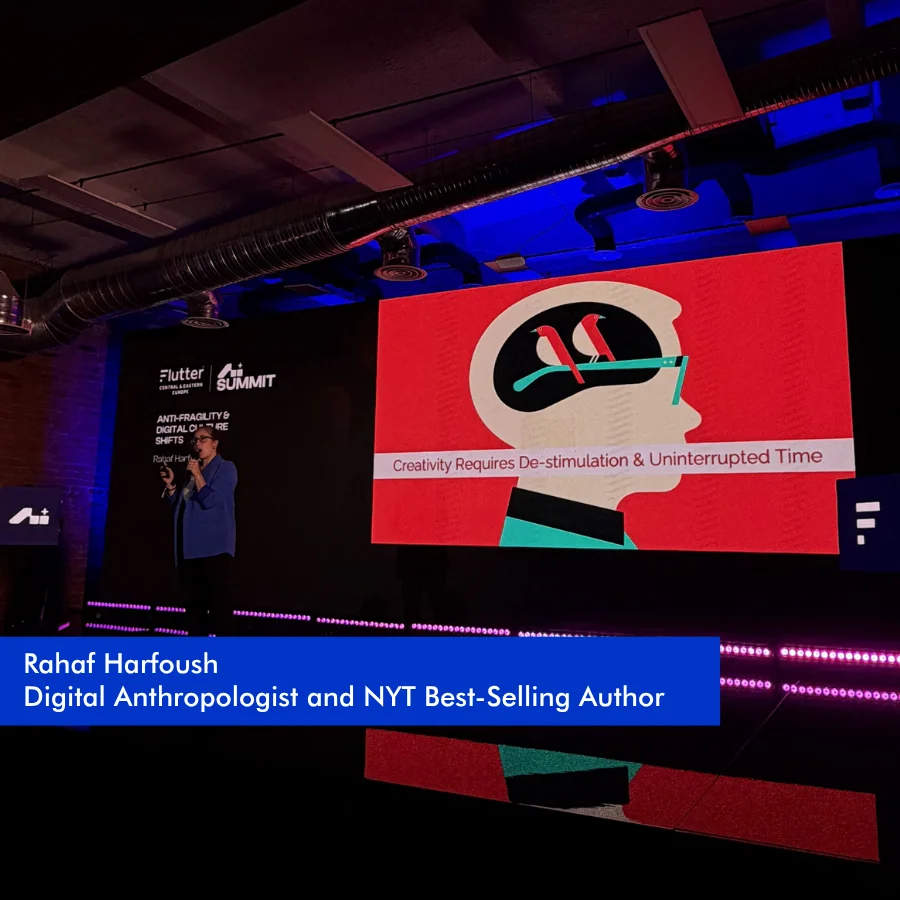
Her talk was memorable for many reasons, but one quote stayed with us most:
“In the age of artificial intelligence, skepticism becomes a survival skill. Human skills are now more important than ever. The knowledge economy is giving way to the innovation economy. Skills like collaboration, creativity, communication, and critical thinking are becoming defining advantages.”
And maybe that leaves us with the most important question for self-reflection:
What are you using AI for – and what does it give you more time for?
Because if it’s not creating more space for creativity, communication, and fundamentally human skills, then are we really using it the right way?